Modern Farmhouse Style in Interiors and Architecture
A gabled roof, wood and a large table by the window: a familiar picture of modern farmhouse style. We look at what makes the home behind…
Read MoreBright cliffs, a lake, and autumn trees — this is what the former granite quarry in Pocheon has become. We explore how stone is extracted for construction, examine the traces of work on the rocks, and recall the drama “Hwayugi.”
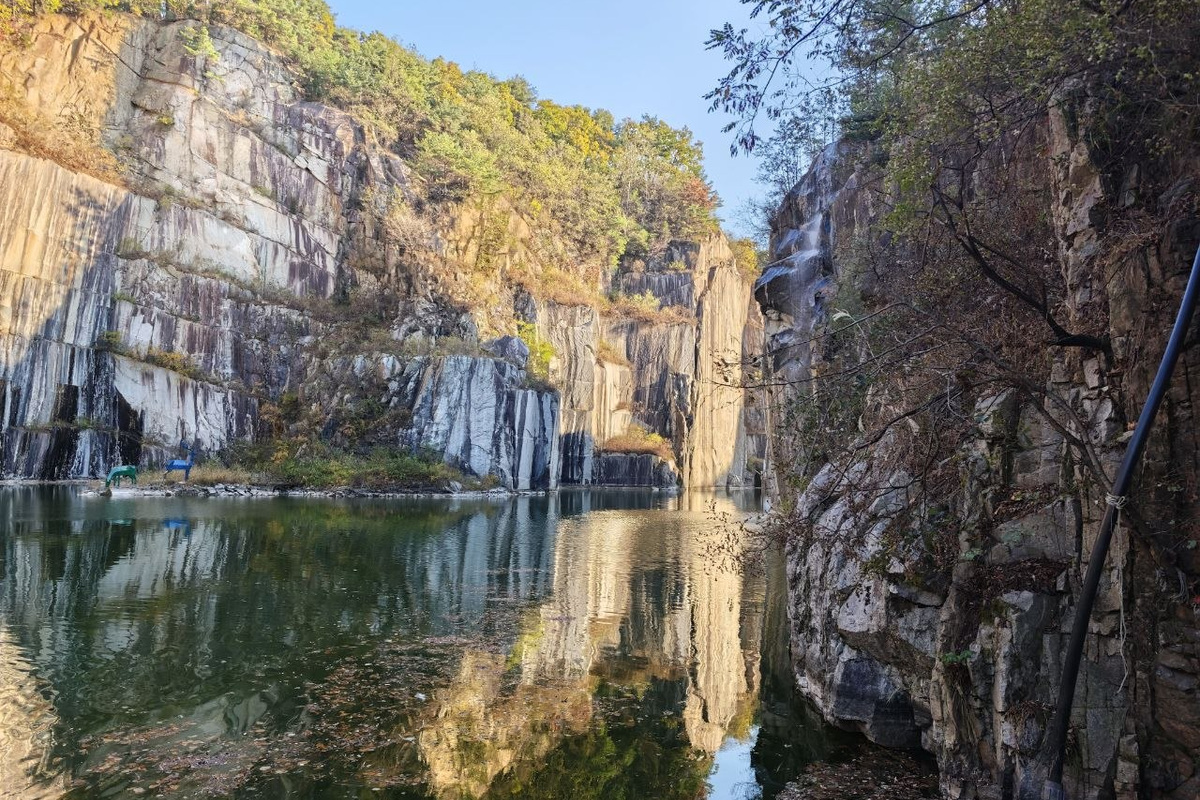
At first, you look at the water. It reflects the bright cliffs, dark pines, and autumn trees that somehow settled on the most inconvenient ledges. Then you raise your eyes and notice the strange regularity of the stone walls. The surfaces are too even, with long vertical grooves and large rectangular indentations. This landscape clearly had work done on it before it became a beautiful place for walks.
The Art Valley in Pocheon, or Pocheon Art Valley, appeared on the site of a former granite quarry in the South Korean province of Gyeonggi-do. Its story is particularly interesting if you love to examine materials: here you can see granite on the scale of an entire cliff and imagine the journey it takes to a facade, staircase, or countertop.
The main attraction in the valley is Cheonjuho Lake. According to the description of the park, it was formed when spring and rainwater filled the quarry. The bowl of the future lake was gradually created by stone extraction. Now, the remaining walls of the quarry are reflected in it.
In autumn photographs, it is especially clear how differently the neighboring sections of granite appear. The sunny side looks honey-colored, while the shaded side appears cold, almost silvery. Dark streaks run along the walls, and bushes grow between the ledges. If you only look at the reflections, it’s easy to forget where this almost vertical stone frame around the water came from.
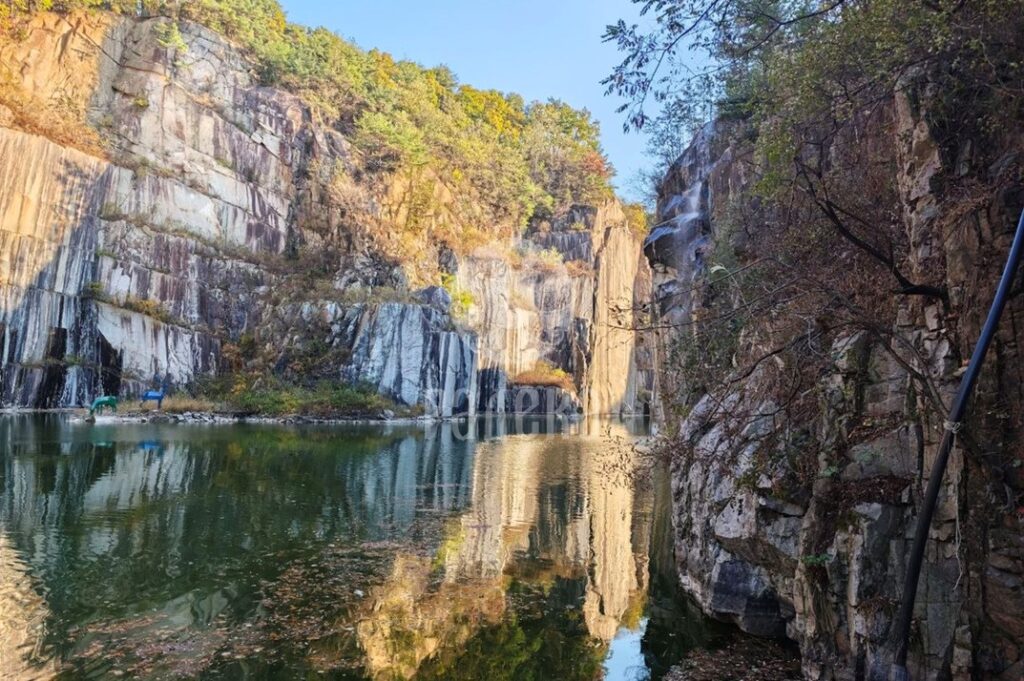
Granite was extracted here for about thirty years, starting from the 1960s. The local stone is known as Pocheonseok — Pocheon stone. It was used in major Korean buildings; the official Visit Korean Heritage project lists examples such as the Cheongwadae complex and the National Assembly building. This refers to the use of Pocheon stone: the region has had and continues to have several extraction sites.
In the 1990s, the extraction of quality granite in the area of the future art valley decreased, and the quarry was abandoned. This does not mean that all granite production ended in Pocheon. For a quarry, the yield of usable material is important, not just the presence of rock. In neighboring quarries, Pocheon stone continued to be extracted.
According to the Korea Tourism Organization, the city worked on transforming the area from 2004 to 2009. In October 2009, the former quarry opened as an art valley. In its new layout, recognizable traces of extraction were preserved, adding walking paths and cultural venues. Therefore, the origin of the place can still be read from the walls themselves.
The history of granite itself is much longer than that of the quarry. The Hantangang Geopark classifies local granites as igneous formations related to events that occurred about 190 to 150 million years ago. The stone originated deep in the Earth’s crust, where magma cooled and crystallized. The familiar graininess of granite consists of individual mineral grains, primarily quartz and feldspar, with the participation of mica and other minerals.
Over time, the rock has moved closer to the surface, cracked, and weathered. In photographs, areas broken by cracks into separate pieces are visible next to wide flat surfaces. A massive rock may seem completely monolithic from a distance, but for the extraction of building stone, its internal structure is crucial.
Here, another aspect is particularly evident: working with the material begins long before the installation of natural stone. To obtain a large solid piece, you first need to find and preserve a suitable blank within the rock mass.
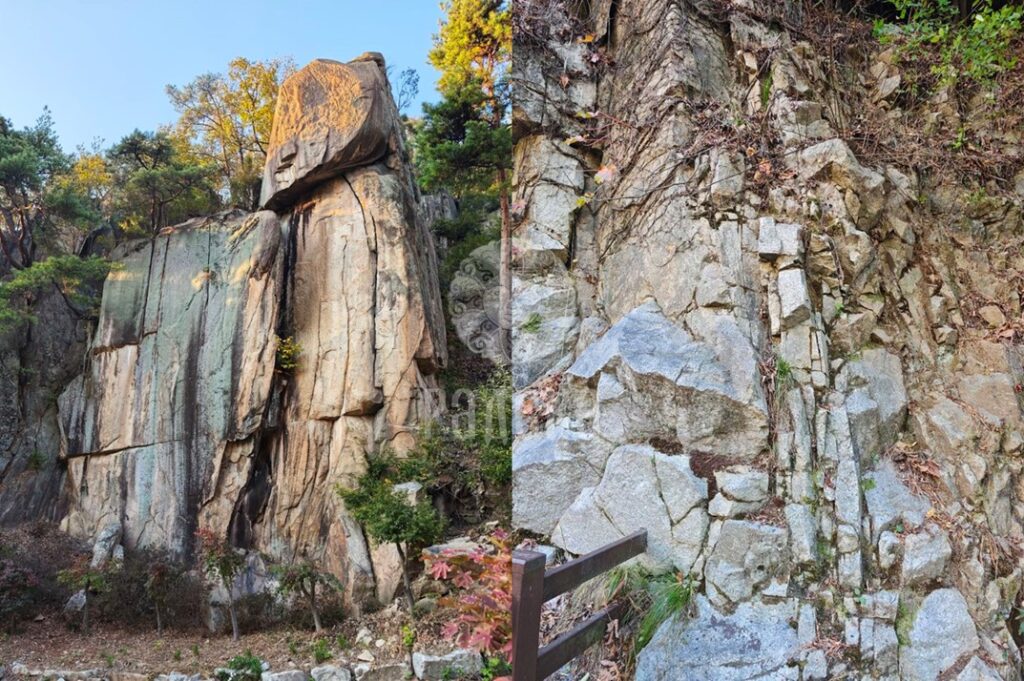
The extraction of granite for cladding has a simple task: to extract a sufficiently large and quality block from which the desired product can be made. If the future blank is broken into small pieces, it will not be possible to assemble a solid slab from them. Therefore, in block extraction, much attention is paid to cracks, the direction of separation, and the precision of work.
Today, several technologies are used for this. Let’s consider the general path of the stone: it helps to understand the layout of the quarry, although the specific set of equipment has changed over the years and at different deposits.
Geologists assess the composition and condition of the rock, the location of cracks, and the size of the sections between them. A frequent network of cracks limits the size of a solid blank even before the machine approaches the rock. In a report by the Norwegian Geological Survey, it is noted that fissuring is one of the key factors in assessing a cladding stone deposit.
Next, the overlying soil and unsuitable upper layers of rock are removed to expose the working face. The quarry is developed in benches, giving machinery access to the stone. The size of the blocks is determined by the structure of the rock mass and the requirements for transport and processing.
One method is diamond wire sawing. Its working part looks like a flexible steel wire with cutting elements containing diamond grains. The wire moves in a closed loop and gradually cuts through the rock. To carry this out, connecting holes are pre-drilled in the rock mass; during cutting, water is supplied to cool the tool. The description of such a process is provided in a study on block stone extraction.
The stone is also split using wedges, including hydraulic ones. A series of holes are made along the designated line, and the wedges installed in them create a force that opens the crack. This principle has long been familiar to stonemasons; modern mechanisms allow for force development without heavy manual labor. Splitting is also used when dividing an already separated large block into smaller blanks.
Controlled blasting is also used in dimension stone quarrying. The aim is to separate the stone with minimal damage. Therefore, the assertion that granite for products is always extracted exclusively by sawing or, conversely, is necessarily blasted into rubble oversimplifies the actual work of the quarry.
The separated stone is moved by machinery, sized appropriately, and sorted. The blank then goes to sawing. From it, slabs are obtained — large plates from which parts are then cut according to the project. In modern granite processing, multi-wire machines are also used: several cutting wires allow for obtaining a series of slabs from a single block.
At this stage, it is already clear why one small sample does not tell the whole story about the future product. The sizes of available slabs, the pattern, the condition of the stone, and the placement of parts during cutting are important. These questions should be resolved even when choosing natural stone for a project.
Then, the surfaces are given the desired texture. Polishing makes it smooth and shiny, while other types of processing allow for a matte or distinctly textured surface. For granite, for example, bush-hammering is used — processing with a striking toothed tool. The rock remains the same, but its appearance and feel change. The texture should be selected considering the place of use: the requirements for a countertop and outdoor steps differ.
After such an introduction to extraction, you look more closely at the walls of the art valley. They alternate between wide flat areas and uneven chips, with ledges and long stripes visible. The overall appearance clearly indicates the extraction of large volumes of stone. However, determining from a single photograph the tool that left each groove would be too bold.
It is worth taking a closer look at the cracks. They help to understand a very practical thing: even strong stone can be split. Its compressive strength and behavior when bending or opening a crack are different properties. Here, the explanation gains a very convincing scale: a whole wall of the quarry is before your eyes.
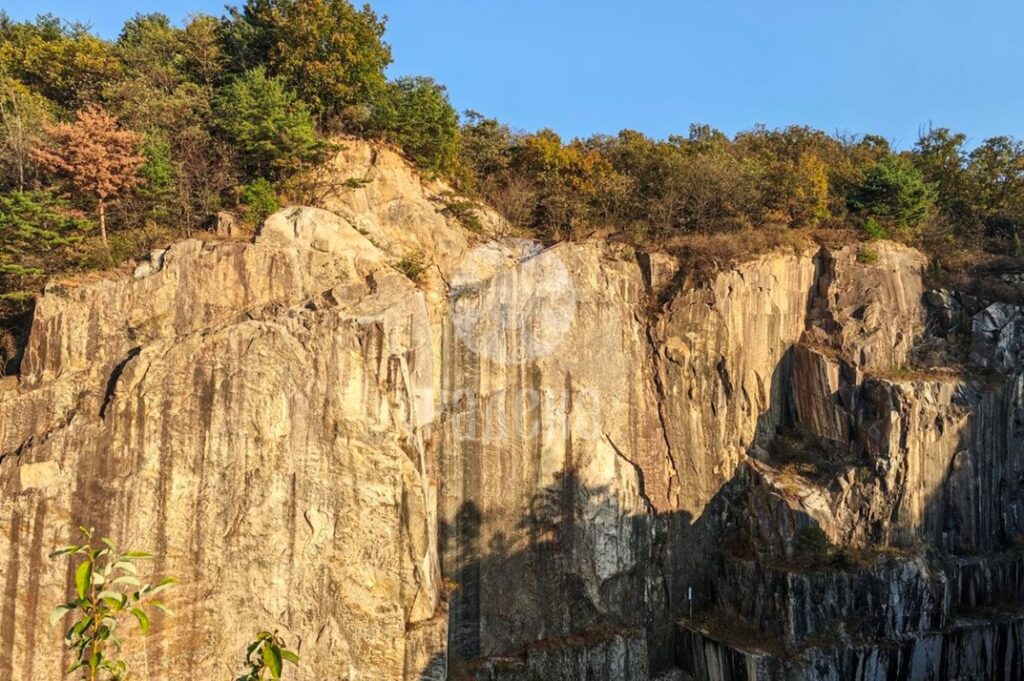
This place also has a familiar side for fans of Korean stories. The drama “Hwayugi” — A Korean Odyssey was filmed here. The art valley is indicated among its filming locations by the official portal of Gyeonggi-do.
It’s easy to understand the choice of the filming crew. The high walls enclose the space, the water doubles their height in reflection, and the trees cling to the stone ledges. Such a landscape already has a mood for a story about the meeting of the human world with something inexplicable. And it’s amusing to remember that this expressive decoration was largely created by people engaged in a completely practical task — the extraction of building stone.
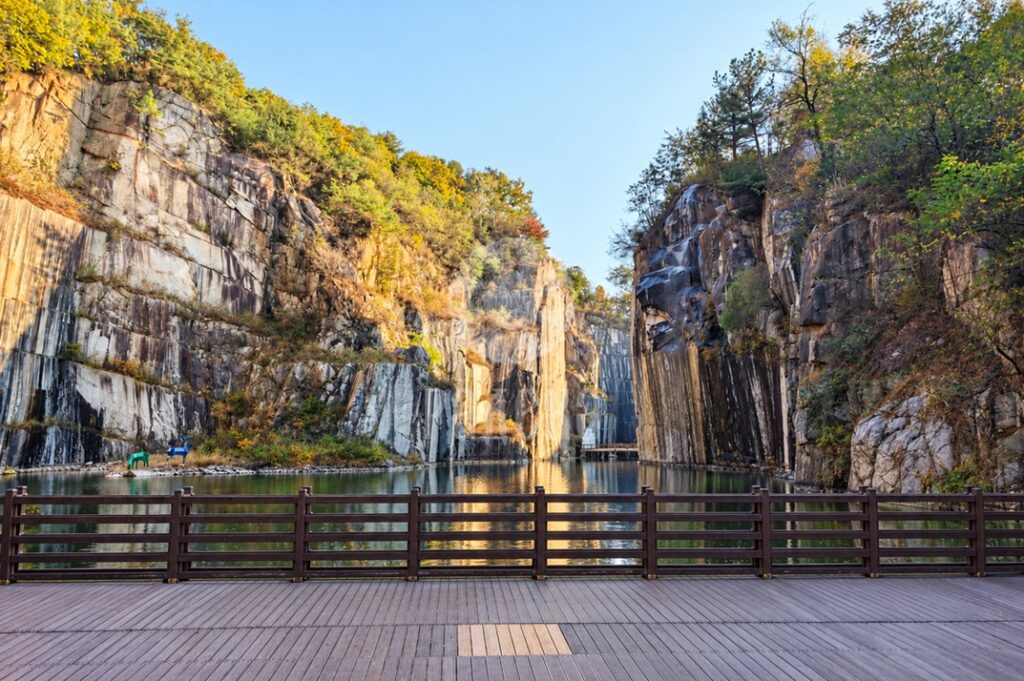
The art valley does not end at the viewing platform. The area features a sculpture park, exhibition spaces, performance venues, and an astronomical science center. Among the sculptures are works made from local granite. The familiar Pocheon granite can be viewed here as an artistic material.
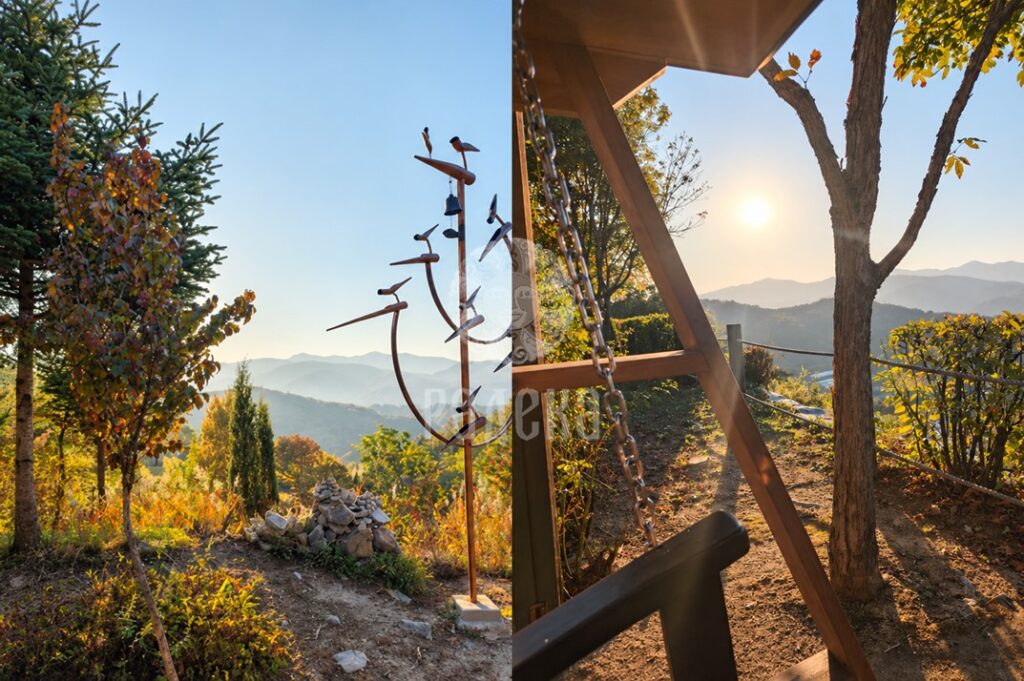
On the walking paths, attention shifts to small things: the delicate silhouettes of birds in a park composition, a bell, light filtering through pines, stones under fallen needles. After the large vertical wall, these details are particularly delightful. The scale becomes human again — you can walk slowly and examine what is very close.
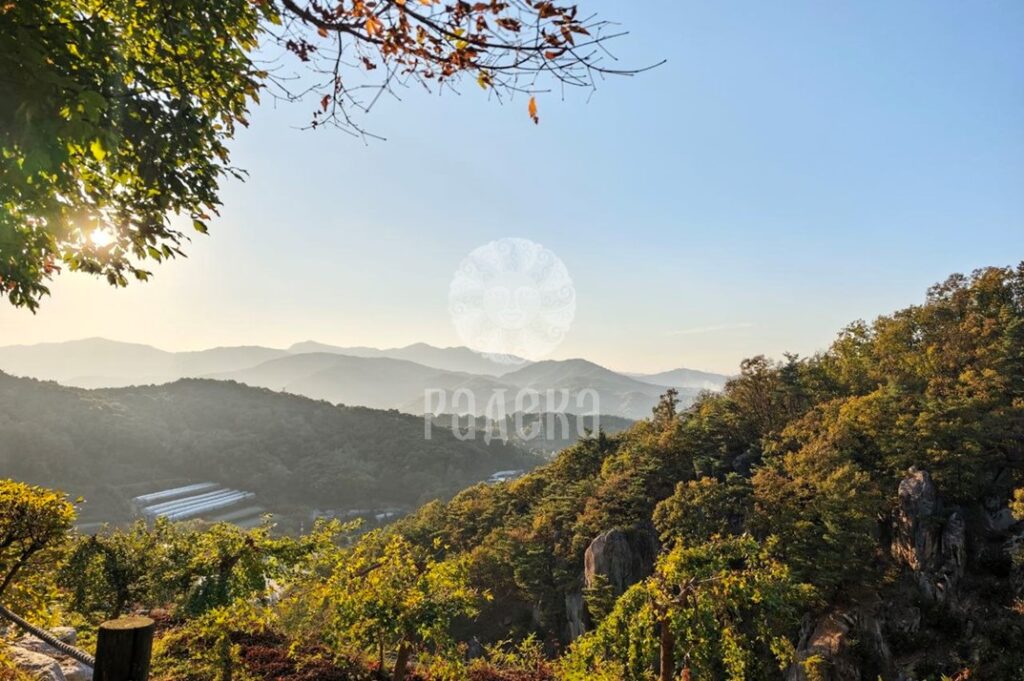
From the high points, the surrounding hills are visible. In the autumn light, the distant ridges gradually dissolve in the haze, while nearby the leaves and texture of the rock are still clearly visible. For such a view, it is worth leaving time for a walk, even if the main point of the trip was the lake.
A climb leads to the main part of the complex; a monorail is provided for visitors. Before the trip, it is convenient to check the official website of the art valley: it publishes operating hours, ticket information, and announcements about closures. Comfortable shoes are advisable on the route — there are slopes and stairs.
In the blog, we have already talked about the second life of limestone, when finished stones received a new purpose in buildings. In Pocheon, the extraction site itself has gained new meaning. It retains the disrupted relief and open walls of the quarry, while paths, art, and the opportunity to see the history of the material with your own eyes have emerged. This is a successful redevelopment of the area, not a return of the mountain to its pre-work state.
After such a walk, it is easier to imagine an ordinary granite step as part of a large cliff. Behind its even edge stands a section found in the rock mass, a carefully separated block, sawing, and the work of a craftsman. In the art valley, this path can be mentally traversed in reverse — from the familiar material to the stone walls above the water. And then, you can stand by the lake for a while. The autumn light on the granite deserves completely aimless attention.
RADEKA | Made by craftsmen