Modern Farmhouse Style in Interiors and Architecture
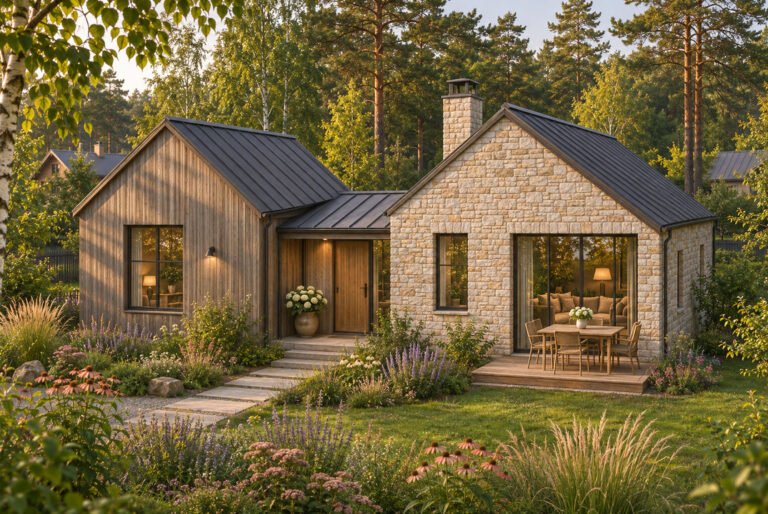
A gabled roof, wood and a large table by the window: a familiar picture of modern farmhouse style. We look at what makes the home behind…
Read MoreGreen or sloped roof — a debate where one wants to choose a winner. But the professional answer starts with two questions: why do you need this roof, and what are you ready to do for it? We compare green operational and metal sloped roofs based on loads, maintenance, safety, and the owner’s lifestyle.
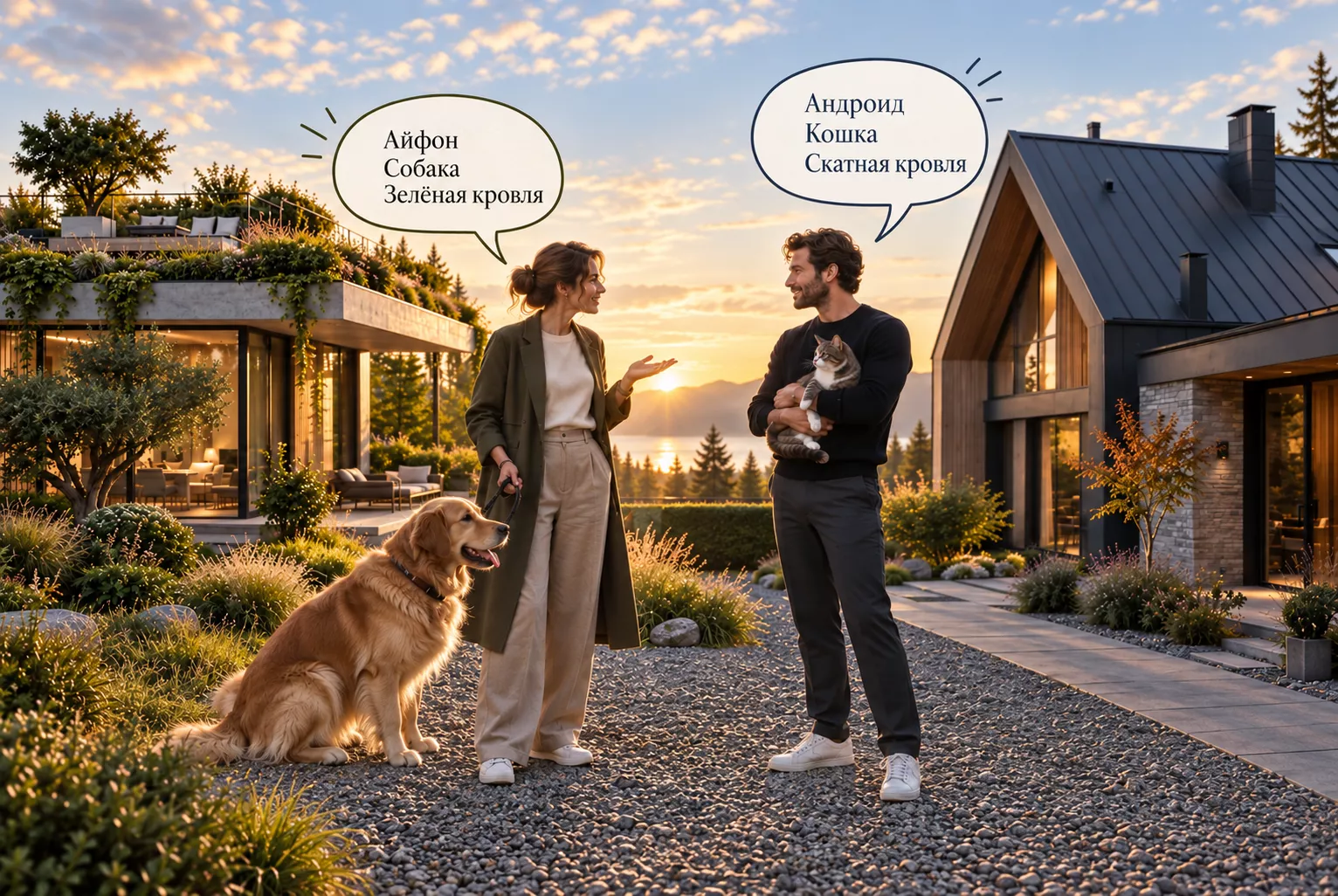
iPhone or Android? Cat or dog? City or country life? Green roof or sloped metal roof?
People generally like to choose a winner. It’s more comfortable for us when we can check one option and declare the other wrong. Especially when it comes to a house: the investments are significant, the decision is made for years, and making a mistake is frightening. We want someone to confidently say: do it this way — it’s right.
Alright. If you need a short answer to the question of which roof is better, here it is.
The one that suits you, your house, and your life right now.
Not the most striking answer for a comment debate. But it is professional.
Because a green roof can be a fantastic solution for one house and a completely unnecessary burden — in every sense — for another. A sloped metal roof can either be a boring compromise or the most sensible choice that frees the owner from tasks they are simply not ready for right now.
And before choosing the material, the color of the metal, or the plants, it makes sense to answer just two questions:
Why do I need this roof?
and
What am I ready — and able — to do for it?
Let’s start with the green one.
If the answer sounds like “because it’s trendy right now,” I wouldn’t rush to open the plant catalog.
A green roof is not just a decorative cap on a house. Its real value emerges where it returns to a person what they truly lack: plants, space for relaxation, contact with nature, the opportunity to step out of a building not onto tiles or asphalt, but into a living environment.
This idea is especially clear in densely built areas. Land is becoming increasingly expensive, the plot is occupied by the house, driveways, parking, terraces — and the familiar garden is shrinking. A roof allows you to literally lift part of the landscape up.
There can be a small garden. A quiet terrace. Herbs and shrubs. A place for loungers. An outdoor kitchen. A barbecue. And with appropriate design — a much more serious recreational area.
And this is not just a story about a beautiful view from the window.
Research on green spaces in general shows a positive correlation between contact with nature and psychological well-being and recovery from stress. The World Health Organization makes an important caveat: there is no single type of green space that is “ideal” for all people, in all places, and in any situation. And I really like this formulation (by the way, I’m a real person with over 20 years of experience in construction, not AI) — because it fits roofs almost perfectly.
Greenery can indeed make a home more pleasant to live in. But it doesn’t work like a pill: you can’t just lay grass on the roof and automatically become calmer and happier.
First, you need to understand how you plan to use this space.

Here, the romantic part ends and engineering begins.
There is a big difference between thin extensive greening with unpretentious ground cover plants and a full-fledged garden where people walk, with furniture, large shrubs, or trees.
The former usually has a small substrate depth and relatively low maintenance needs. An intensive green roof is essentially a real landscape above the building: with a deeper substrate, irrigation, pathways, rest areas, and full-fledged plantings.
And the closer our dream is to an ordinary garden, the more typical garden tasks come along with it to the roof.
Plants need to be watered. Some need fertilizing. Unwanted vegetation needs to be removed. Drainage areas and water collectors need to be monitored. The lawn needs maintenance. Shrubs need shaping. The condition of the plants needs to be tracked.
Even so-called low-maintenance extensive roofs do not mean “set it and forget it.” Industry recommendations for such roofs provide for regular visits for monitoring and maintenance; for intensive greening, the need for watering and maintenance logically increases.
And here comes the second question.
This question is much more important than it seems.
You can love greenery very much. You can dream of stepping out with coffee onto the roof in the morning, trimming lavender, and watching your dog roll in the grass.
And then an ordinary Tuesday comes.
You have work. Kids. Parents. A dog. Business trips. Traffic jams. Conference calls. Twenty unread messages. A postponed dentist appointment and a person you’ve promised to call back for the third day.
And it turns out that someone on the roof also wants attention.
Yes, a significant part of the maintenance can be automated. You can plan for automatic irrigation, choose resilient plants, and contract a maintenance company.
But automation does not turn a garden into inanimate building material.
It remains a garden.
And if the thought of yet another system that needs monitoring causes not pleasure but a slight nervous tick, that is a perfectly valid argument against having an intensive green roof.
Not because you are lazy.
Not because you have “not grown up”.
And not because a green roof is “beneath your status”.
Just because life is already busy enough.
No judgment. One hundred percent understanding.
Sometimes an extra obligation can take away more peace than the most beautiful garden can return later.
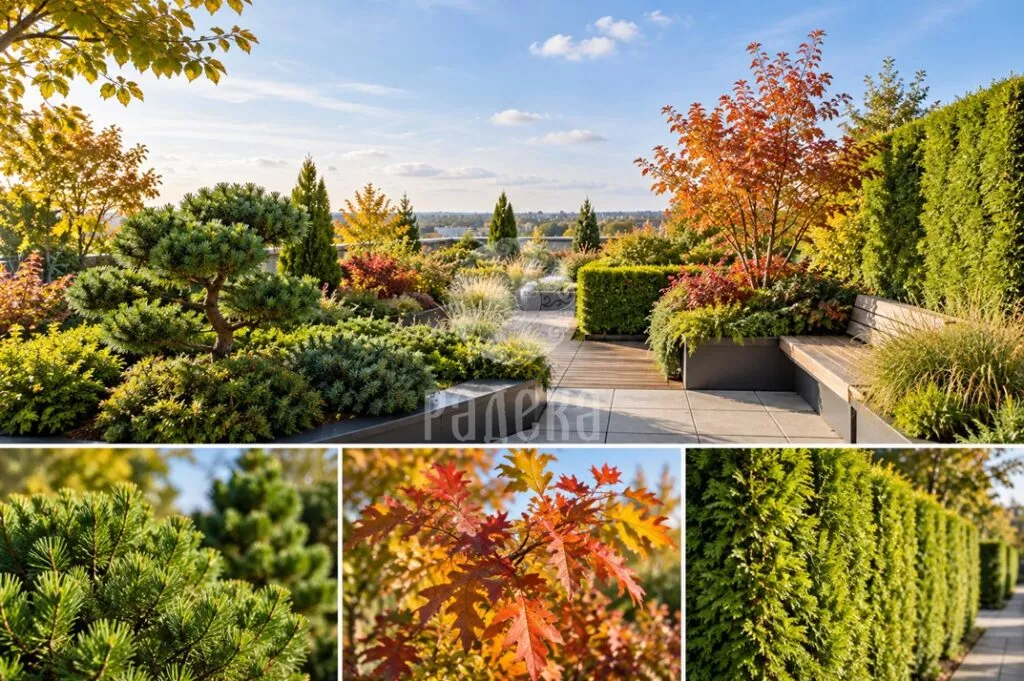
Let’s assume that maintenance doesn’t scare you.
You want a garden. You are ready to take care of it. You are already choosing plants and mentally placing a lounger.
The next question is much more mundane:
Can the house actually support all this?
If a green roof is planned for a new house during the design stage, the task is clear: the structure is calculated from the outset with consideration for the future system, water-saturated substrate, plants, people, furniture, pathways, equipment, and other loads.
It becomes much more interesting when the house already exists.
The Russian SP 17.13330.2017 directly requires that when designing a green roof on an existing building, the load-bearing capacity of the structures and the condition of the roof itself be checked. GOST R 58875-2020 requires consideration of additional loads from people, equipment, greening systems, and other elements. For large shrubs and trees, weight limits and necessary solutions are determined by the project.
And here it is important to eliminate one popular simplification.
It’s not just about making the “slab thicker” for a green roof.
You have to consider the entire structure.
Waterproofing. Root protection. Drainage and water accumulation. Substrate — in a fully saturated state. Plants. Pathway coverings. Furniture. People. Equipment. Snow. And if a tree appears — its own mass, root ball, and wind load.
That’s why a flat roof planned for greening and operation should be viewed not as an empty horizontal platform, but as part of the building’s load-bearing system.
And the numbers start to change very quickly.
Regulatory documents differentiate between extensive, semi-intensive, and intensive greening; for intensive green roofs, the substrate layer starts from 300 mm, and larger plants and trees require individual calculations. The scale of the difference between a thin layer of ground cover plants and a real garden on the roof is enormous.
Between a thin layer of sedum and a tree on the roof lies a whole engineering world.
On the ground, a tree is supported by its root system in a huge volume of soil.
On the roof, the conditions are different.
The amount of substrate is limited. The height of the building increases wind exposure. Wind pressure arises. The root ball must be calculated and secured so that the tree does not become a dangerous object in strong winds.
This is not theory.
On the roof of the Rotterdam Depot Boijmans van Beuningen, 75 birches about six meters tall were planted. Their root balls were specially secured considering high wind loads, and irrigation was organized using collected rainwater.

At CopenHill in Copenhagen, the root balls of individual trees weighed up to 2.5 tons and also required special retaining structures.

This is what a green roof looks like when it is designed seriously.
Not “laid down some soil and planted a birch.”
But a full-fledged engineering and landscape system.
So if the calculation of the existing house indicates that the required load is not supported by the structure, there is simply nothing to argue about.
You can change the concept. Reduce the substrate depth. Switch to a lighter type of greening. Abandon trees. Use container greening — if the calculation allows it.
But you cannot pretend that structural limitations do not exist just because you really want a beautiful picture.
Here, I want to respond without any architectural poetry.
The owner’s risk does not absolve the designer and contractor of responsibility.
There are solutions where you can discuss color, shape, or cost.
And there are solutions where it’s about load-bearing capacity, stability of elements, and safety of people.
If the structure is not designed for the expected load, the client’s desire does not turn it into a calculated one.
For a construction company, a normal professional position in such a situation is not to look for a way to “make it work somehow,” but to refuse a dangerous solution or propose another one.
Because the consequences of a mistake here are measured not by re-wallpapering.
Let’s imagine another owner.
They like modern architecture. They want a beautiful house. But there is already a space for relaxation on the plot. Or there’s a forest nearby. Or the plot is large enough not to need to move the garden to the roof.
They work a lot.
They don’t want another greening system, automatic irrigation, and a maintenance schedule.
And the existing structure of the house perfectly allows for a sloped metal roof.
Why should they feel like they’ve chosen something less interesting in this situation?
They shouldn’t.
A metal roof solves a different task.
It does not create an additional garden. Instead, it provides a durable outer shell with much less regular work compared to intensive greening. With proper installation, maintenance of a metal roof mainly consists of periodic inspections, monitoring the drainage system, cleaning debris, and promptly addressing any identified damage. There are no roofs without maintenance — and metal is no exception — but this is a different scale of owner involvement.
Architecturally, metal has long ceased to be limited to the image of a “standard gable roof.”
Standing seam roofing allows for long slopes, bends, radii, complex connections, and very different styles. Copper, titanium-zinc, and steel provide a completely different character to the surface.
So we are not comparing an “interesting green roof” with a “banal metal one.”
We are comparing two different life scenarios for the house.
It would be unfair to reduce everything to maintenance and weight.
A green roof can solve tasks that a metal roof simply does not have to address.
It retains some precipitation and slows down water runoff, participates in cooling the building’s surface, can create an environment for insects and birds, and returns green space to areas already occupied by development. For intensive roofs, there is another advantage — essentially additional usable space.
Therefore, in the center of dense urban development or on a plot where every square meter of land is already occupied, a roof garden can provide the house with what it otherwise simply would not have.
And then all the additional calculations, maintenance, and costs become not a drawback, but the price for a necessary function.
The key word is necessary.
The most dangerous point of choice occurs when a person answers not the question “what do I need?” but the question “what is currently visually appealing?”
Today, green roofs are visually attractive.
Tomorrow — fully glazed facades.
The day after tomorrow — some new architectural technique.
But a house is not a social media feed.
You can’t swipe it away in three years when the trend gets boring.

Good architecture generally does not get along well with solutions that arose only because everyone is doing it now.
If a green roof truly provides your home with an additional garden that you lack — great.
If you want to grow plants, spend time there, are ready to maintain the system, and the building’s structure allows it — even better.
But if the only reason sounds like “I saw someone have it, it looks expensive,” it might be worth asking yourself again:
Why?
There’s another problem with our favorite debates: they force us to choose only between two options.
Either a full-fledged green roof.
Or no greenery at all.
But life usually offers more options.
Sometimes it’s better to make a sloped metal roof and leave the plants on the ground.
Sometimes — to create an operable terrace with container greening.
Sometimes — to settle for an extensive roof with unpretentious plants instead of a garden with trees.
Sometimes — to invest in landscaping the plot.
And this is also a normal professional choice.
A solution does not have to be maximally complex to be good.
So before choosing between a green and a sloped metal roof, I wouldn’t ask:
“Which one is better?”
I would ask something else.
What exactly should the roof provide?
The answer sharply reduces the number of beautiful but unnecessary options.
And the second question:
Not just how much money to invest at the start.
Only after this does the conversation become much more interesting.
The one that allows you to live comfortably after construction.
Not just to photograph for the first two weeks.
Not to explain to acquaintances how much it cost.
But to actually live.
For one person, it will be a real garden above the house: with herbs, trees, a summer table, and Sunday breakfasts on the roof.
For another — a neat sloped metal roof that they see from the garden and about which they hardly think most of the time.
And neither of them is wrong.
Because a professional choice is not about finding a solution that is considered correct in general.
It’s about finding a solution that is safe, technically feasible, useful, and suitable for a specific person at a specific moment in their life.
RADEKA | Made by Masters