
Roofs of the Peoples of Russia
The wooden church of the Russian North, Buryat dugan, Tatar mosque, and Zaonezh house have different silhouettes. One reaches up to the…
Read MoreExpressive stone, refined metalwork, and precise geometry define the language of Art Deco. Explore its history, materials, contemporary interpretations, and common design mistakes. A seven-meter-tall fireplace crafted by RADEKA shows how these principles come together in a completed project.
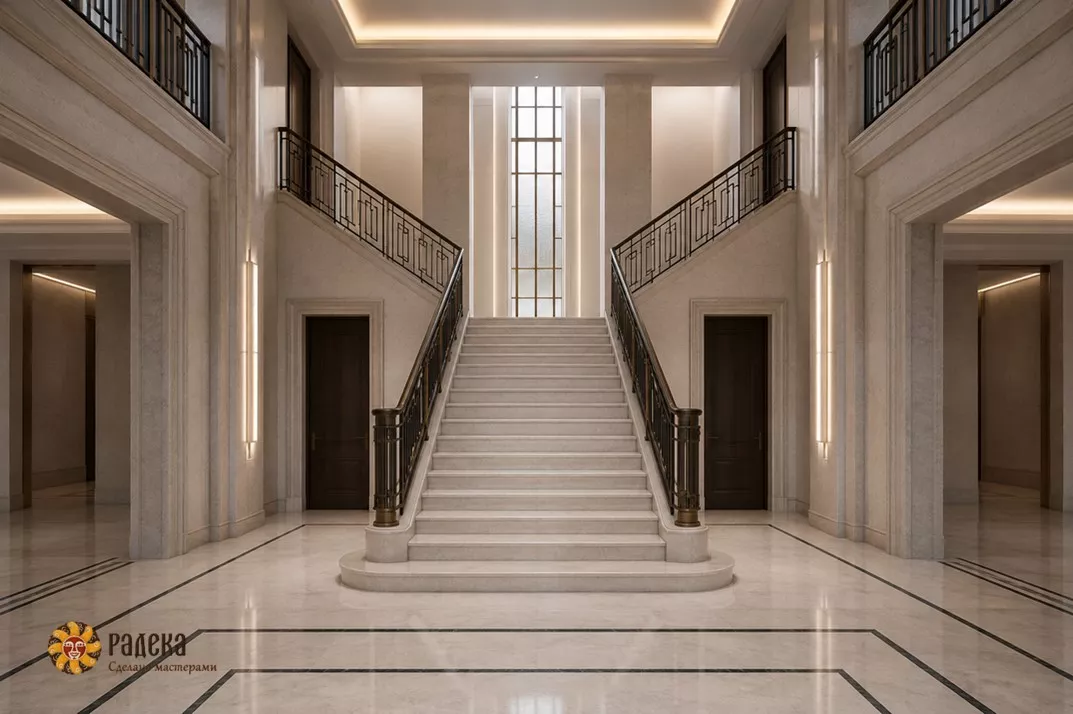
The Art Deco style in interiors is often recognized by its black color, gold accents, and striking furniture. However, this set of features alone does not define the style. True Art Deco is built on a different foundation: clear composition, precise proportions, the rhythm of geometric forms, and impeccable execution of materials. Here, luxury becomes a result of design precision rather than the quantity of shiny surfaces.
In a modern home, Art Deco can appear grand, intimate, or almost minimalist. It does not have to turn the interior into a set for a 1920s film. Much more important is to maintain its internal logic: to combine decorative craftsmanship with a sense of technical progress, natural materials with modern engineering, and expressive details with the comfort of everyday life.
To preserve the intended geometry during implementation, detailed design documentation is essential: drawings for stone layout, metal details, and carpentry elements, coordinated with lighting and engineering systems.
Art Deco began to take shape in France even before World War I and gained international fame after the 1925 Paris Exposition of Decorative Arts and Modern Industry. The name “Art Deco” itself became established much later, in the 1960s. Contemporaries often referred to it as Style Moderne — the modern style.
Art Deco does not have a single source or a strict set of canons. It absorbed the geometric forms of late Art Nouveau, ideas from cubism, futurism, constructivism, and other avant-garde movements. Its ornamentation was also influenced by ancient Egyptian, Mesoamerican, African, and East Asian motifs. After the discovery of Tutankhamun’s tomb in 1922, decorative arts frequently featured lotuses, pyramidal silhouettes, solar discs, and stylized rays.
This is the paradox of Art Deco: it looked to ancient cultures but spoke of the future; it valued craftsmanship yet admired the machine age; it used rare materials but later easily adopted chrome-plated steel, aluminum, colored glass, and new plastics. The style turned out to be both artisanal and industrial — a quality particularly close to architecture and construction.
Symmetry and Central Axis. The composition is often built around a fireplace, staircase, portal, mirror, or large light fixture. Even if the layout is not perfectly symmetrical, the interior is perceived as cohesive: the main objects form a clear hierarchy.
Strict Geometry. Stepped forms, zigzags, chevrons, fans, sun rays, concentric frames, and elongated verticals create a characteristic rhythm. In a good project, these motifs are not scattered throughout the house but repeated in moderation: for example, in the floor pattern, staircase railing, and metal door layout.
Contrast of Planes. Smooth stone coexists with textured wood, matte metal with transparent or ribbed glass, and dark surfaces with light ones. Contrast makes the interior expressive even with a restrained palette.
Decorativeness Subordinated to Architecture. Art Deco loves striking details, but they must support the form of the space. Ornamentation that is not connected to axes, proportions, and materials of the interior quickly turns into superficial decor.
Quality of Execution. This style particularly highlights imprecise joints, uneven layouts, random metal shades, or poorly matched stone patterns. Art Deco requires not only a design idea but also the skill to realize it.
In architecture, Art Deco is recognized by its clear symmetry, emphasized verticals, stepped silhouette, geometric reliefs, and distinctive entrance composition. The facade can be clad in stone, brick, ceramics, or smooth plaster; metal doors, stained glass layouts, railings, and light fixtures usually work as a unified system.
Historical skyscrapers used setbacks not only as a decorative technique: their silhouette was linked to urban planning restrictions and the desire to bring light to the streets. In a private house, it is not necessary to literally repeat the tall composition. It is sufficient to rethink the scale: highlight the central portal, set the rhythm of the pilasters, use a stepped parapet, and combine metal, stone, and glass into a cohesive facade system.
Streamlined corners, horizontal stripes, and porthole windows primarily belong to a later branch — Streamline Moderne. It is related to Art Deco but does not exhaust it. In one project, it is better to choose a dominant line: vertical and stepped or more fluid and aerodynamic.
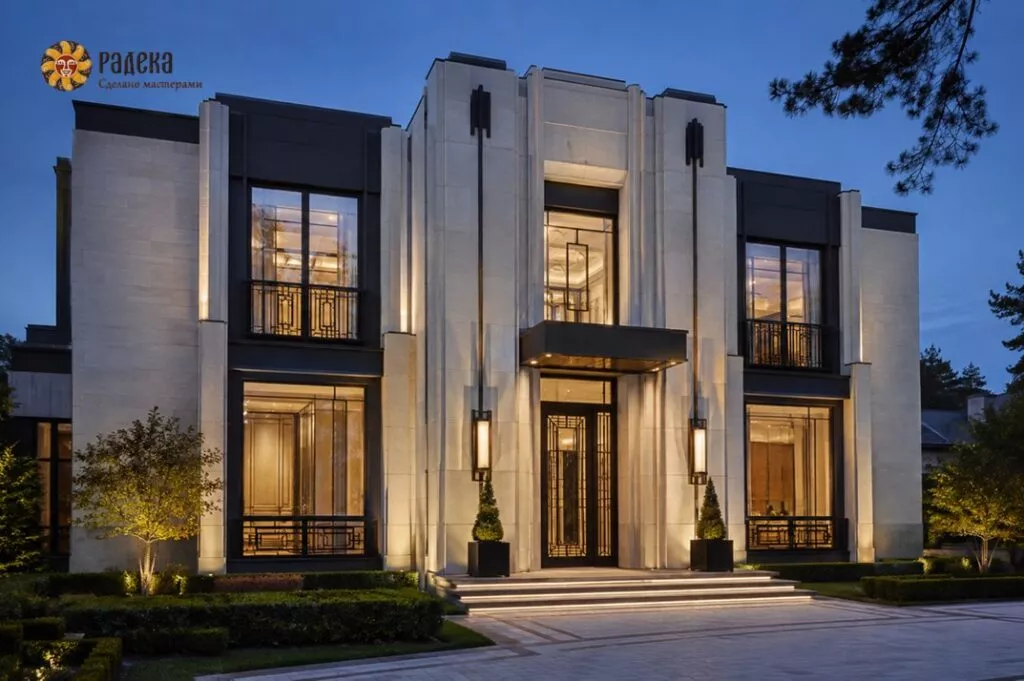
Art Deco loves architecturally readable spaces. The entrance should feel like an entrance, the fireplace — a compositional center, and the staircase — a standalone element rather than a random transition between floors. Therefore, work on the style should begin not with selecting a sofa and chandelier but with the plan, axes of movement, proportions of openings, and lighting scenarios.
In a spacious house, the style unfolds through enfilades, double-height areas, wide portals, and large planes of natural stone. In a small apartment, the same principle works on a reduced scale: one accent wall, an expressive door portal, a rhythmic floor layout, and a few precise metal details will yield more than a dozen items with recognizable ornamentation.
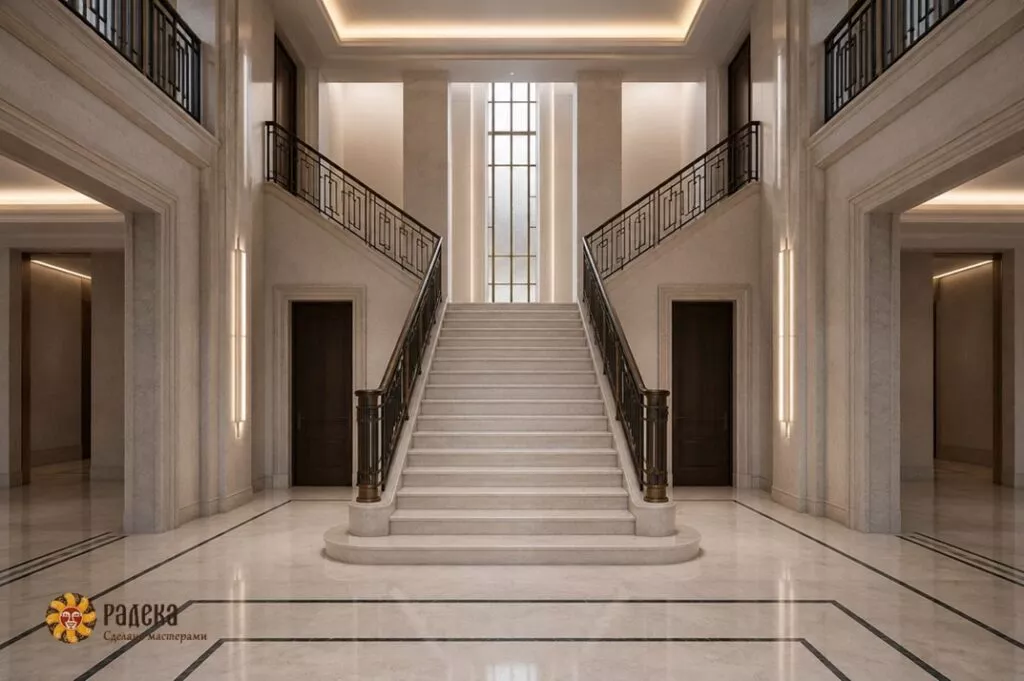
Marble, onyx, granite, travertine, and limestone provide Art Deco not only with a sense of status but also with architectural mass. Stone is used to clad floors, staircases, portals, bathroom walls, countertops, and fireplaces. Symmetrical layouts of slabs, contrasting borders, and thin geometric inlays are particularly expressive.
It is important to select slabs in advance, perform a dry layout, and coordinate the direction of the pattern. Beautiful stone alone does not guarantee results: if the veins break at the seam or outlets and inspection hatches fall in the center of the composition, the expensive material loses its expressiveness.
Before ordering the material, it is essential to consider the sizes of future details, the structure of the base, and the possibility of delivery to the installation site. More on this in the article about why the choice of natural stone should start with project analysis.
Brass, bronze, copper, stainless steel, chrome-plated steel, and aluminum are among Art Deco’s key materials. Metal is used in railings, doors, portals, furniture details, light fixtures, decorative panels, and thin inserts between stone slabs. It sets the rhythm and emphasizes geometry but should not turn into a solid golden shell.
The shade and texture of the metal are chosen at the project stage. Polished brass, satin bronze, and aged copper behave differently in the interior, reflect light differently, and require different care methods. The finish sample should be evaluated alongside specific stone, wood, and light — separately chosen materials may not match in tone.
Historical Art Deco valued exotic species and complex veneering. In modern projects, walnut, oak, Macassar veneer patterns, and deep stains work convincingly. Large calm planes and precise carpentry geometry are important — an excess of carving leads the interior towards classicism.
Transparent, smoky, colored, and ribbed glass softens the massiveness of stone and wood. Mirrors expand the space, support symmetry, and enhance light, but their layout must consider reflections: accidentally doubled doors, televisions, or technical openings disrupt the composition.
The contrast of black and ivory is indeed characteristic of Art Deco, but the palette is much broader. Neutral bases can include milky, sandy, gray-beige, graphite, and chocolate shades. Deep accents can be emerald, sapphire, wine, terracotta, and amber.
Metallic shades are better perceived as materials rather than paint colors. Real brass or bronze gives depth, a lively reaction to light, and noble aging of the surface. Imitation, especially applied to many heterogeneous details, often looks flat and quickly reveals decorative substitution.
Walls. Stone portals, wooden panels, decorative plaster, reliefs, mirror inserts, and metal profiles should form a unified elevation. Special attention is required for corners, door openings, switches, and built-in ventilation grilles.
Floor. Large-format stone, geometric mosaics, terrazzo, or parquet with an expressive pattern direction help establish the axis of the space. Borders and inserts are tied to walls, doors, and furniture, rather than laid out independently.
Ceiling. Stepped cornices, coffered ceilings, and built-in lighting can support the style if they do not reduce the space and do not conflict with engineering systems. A multi-level structure for the sake of the structure itself is one of the quickest ways to make an interior feel outdated.
Art Deco furniture combines a clear silhouette with tactile comfort. It can feature rounded chairs, clean-lined cabinetry, glossy or matte cabinet fronts, stone tabletops, and metal bases. The main thing is scale: a large sofa and striking console require space around them.
Light fixtures often become compositional accents. Cascades of glass, geometric sconces, matte shades, and built-in light lines that emphasize relief are suitable. But decorative lighting alone is not enough. Separate scenarios are needed for general lighting, reading, highlighting art, stone, and passageways.
In decor, sculpture, graphics, lacquered surfaces, geometric panels, and items made of colored glass are appropriate. Art Deco historically absorbed motifs from different cultures; however, a modern project does not need a collection of literal “exotic” quotes. It is better to take the principle of stylization and rhythm than to assemble the interior from random symbols.
Living Room. The compositional center can be a fireplace, stone panel, large mirror, or group of light fixtures. Furniture is arranged around this axis, while other surfaces remain calmer.
Hall and Staircase. Here, the stone floor, portal, geometric railing, and vertical light are particularly expressive. Each junction should be calculated as part of one composition.
Kitchen. The style is supported by symmetrically arranged cabinet fronts, ribbed glass, dark wood, stone countertops, and measured metal profiles. Appliances and ventilation are integrated into the furniture in advance.
Bedroom. Here, Art Deco becomes softer: a high headboard, paired light fixtures, calm symmetry, deep-colored textiles, and one expressive geometric detail.
Bathroom. Stone, brass, glass, and mirrors naturally reveal the style. At the same time, moisture resistance, slopes, waterproofing, access to building services, and anti-slip properties of the floor are more important than decorative layout.
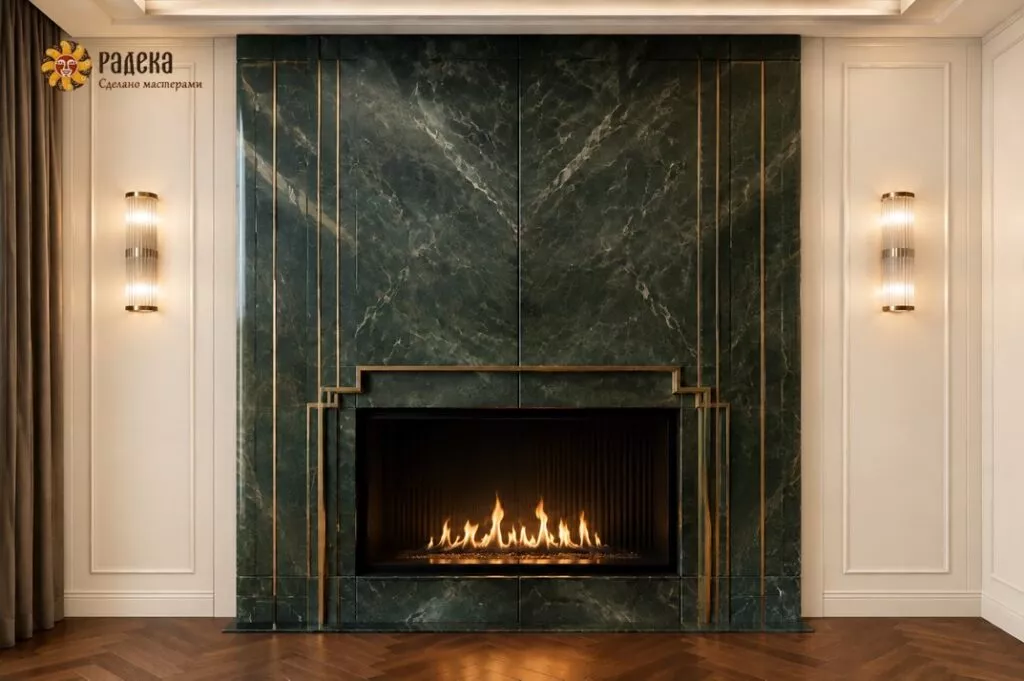
This fireplace is a contemporary interpretation of Art Deco rather than a literal reproduction of the historical style. Its character comes from the overall architectural composition: the contrast between dark and light stone, reflective surfaces, symmetry, and diagonal geometry.
The restrained design of the firebox keeps the composition balanced, while the tall cladding makes the fireplace an architectural focal point of the interior.
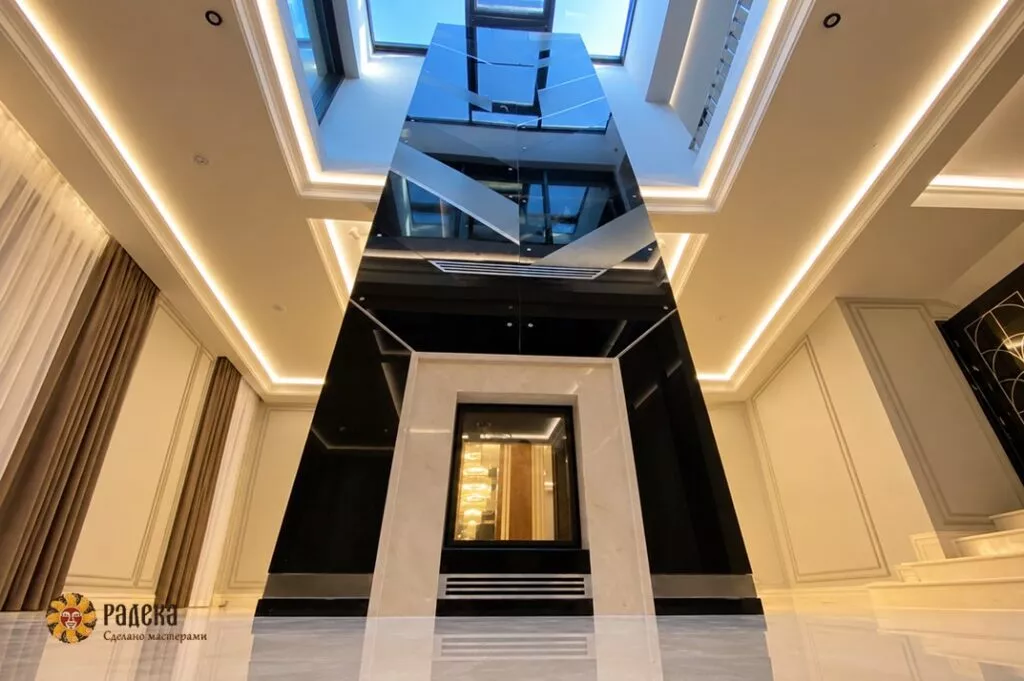
In Art Deco, many elements converge at one point: the stone seam continues the line of the metal profile, the door layout corresponds to the floor pattern, the light emphasizes the wall relief, and the furniture aligns precisely with the architectural axis. If stone, metal, carpentry, light, and engineering systems are developed independently, discrepancies become noticeable during installation — correcting them is expensive and sometimes impossible.
Therefore, renovation and finishing in the Art Deco style begin with measurements, planning solutions, and elevations. Then slabs of stone, metal samples, fastening methods, panel thickness, installation clearances, maintenance access to building services, and installation sequence are coordinated. For complex details, full-size samples are useful: they allow assessing color, light reflection, and joint quality before launching the entire volume into production.
RADEKA combines design, manufacturing, and installation of elements made from natural stone, metal, and wood. This approach is especially important for Art Deco, where the impression is created not by a single expensive item but by the precision of the entire system.
Gold on Every Surface. An excess of shine robs the interior of depth. Matte or satin metal usually looks more noble and better showcases geometry.
Substituting Art Deco with Palace Classicism. Capitals, abundant stucco, scrolls, and heavy curtains may exist in an eclectic project, but they do not belong to the language of Art Deco by themselves.
Random Set of Recognizable Motifs. A sunburst mirror, fan ornament, and chevron do not save a space without proportions and a compositional axis.
Cheap Imitation of Materials. Art Deco emphasizes the surface, so a repeating pattern of artificial marble, peeling metallization, and plastic fittings are particularly noticeable.
Lack of Detailed Construction Drawings. A complex layout without precise drawings leads to cut-off ornaments, different gaps, and conflicts between finishes, outlets, ventilation, and furniture.
Incorrect Scale. In a small room, large stepped cornices, a massive chandelier, and an overly contrasting floor can visually compress the space. The style should be adapted rather than mechanically reduced.
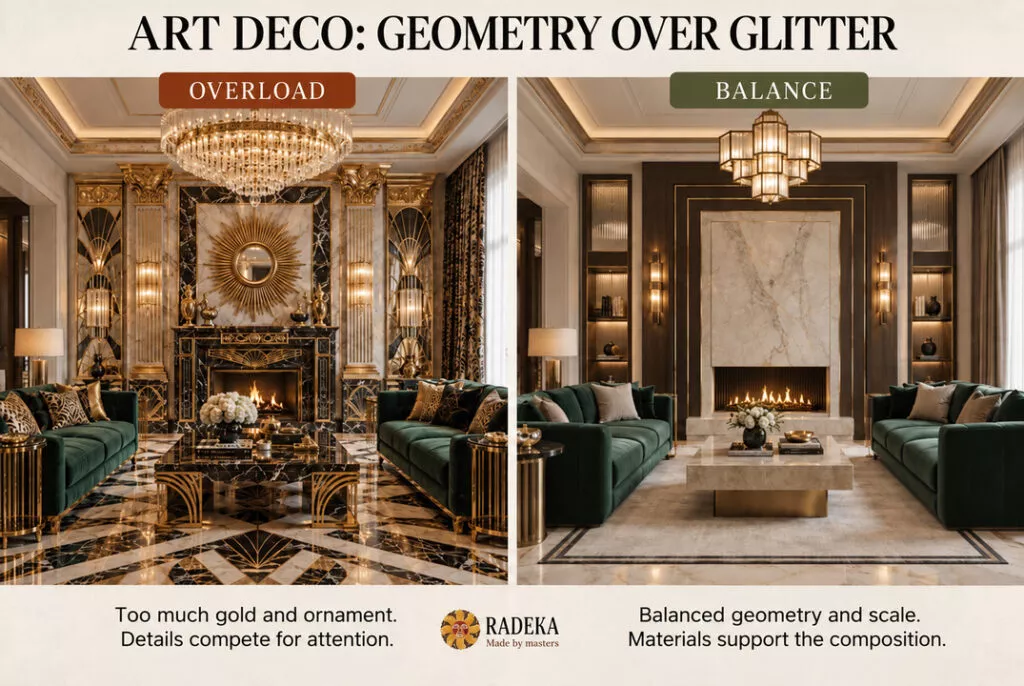
To prevent the interior from looking like a period film set, it is enough to retain a few fundamentals: axial composition, rhythm of geometry, contrast of textures, and high quality of key materials. The rest can be quite modern — from hidden doors and streamlined furniture to smart home systems and energy-efficient lighting.
The best modern Art Deco does not showcase the cost of each detail. It creates a different impression: the space appears cohesive, confident, and individual. The stone is selected by pattern, the metal has the right depth of shade, joints are almost invisible, and light turns on precisely where it should reveal the architecture.
This style is chosen by those who appreciate order, expressive geometry, deep colors, and materials with character. It is suitable for private houses, high-end apartments, hotels, restaurants, offices, and public spaces. But the main condition is the readiness to consider the interior as a cohesive project rather than a collection of decorative purchases.
If you are planning a fireplace with Art Deco elements, RADEKA specialists will help you work out its design and finishing, prepare working drawings, select materials, manufacture elements, and carry out installation. The scope of work and cost are determined individually based on the project.
RADEKA | Made by masters