Hammam in a Private House: What to Consider Before Finishing
Warm stone, soft light, steam. But what happens behind the mosaic and where does the moisture go after the session? We analyze the…
Read More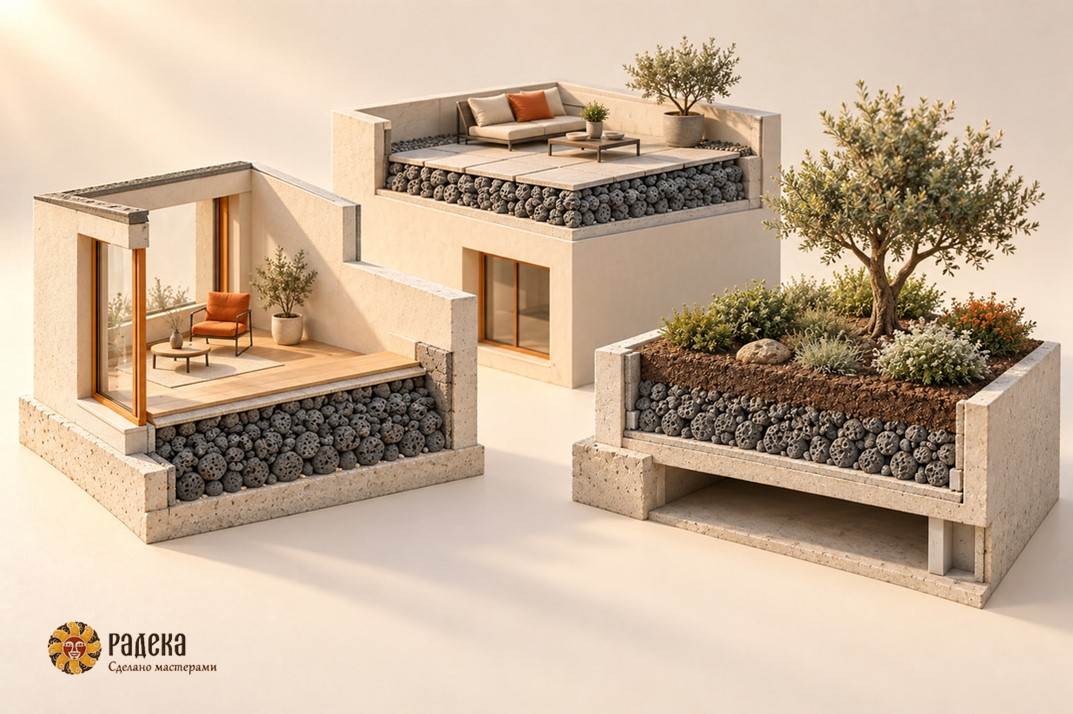
Foam glass gravel looks unremarkable: gray porous pieces, uneven edges, no decorative shine. Its function is usually not visible at all. The material is hidden under the floor, within the roofing thickness, or inside embankments, where it reduces heat loss and helps decrease the weight of the structure.
One might want to ask this insulation material primarily one question: “What will you be like in thirty or forty years?“ After all, replacing the fill will require dismantling everything above it. Foam glass has been used for several decades, and during this time, data from building surveys and material tests after long service have emerged. They help understand how it retains its properties and what conditions are necessary for this. We will start with these examples and then discuss the characteristics of modern foam glass gravel and the rules for its installation.
Foam glass gravel is produced from finely crushed glass with the addition of a foaming agent. When heated, the mixture foams: numerous cells are formed inside, separated by thin glass walls. After cooling, the material acquires a solid porous structure. The foamed mass cracks into separate pieces upon cooling.
Recycled glass is also used in production. Glass shards are crushed and processed into new material: bottle or window fragments do not become insulation by themselves.
The closed cells within the grains explain the combination of low weight and thermal insulation properties. The spaces between the grains themselves determine the behavior of the fill: water can pass through them, and their relative positions change when compacted.
Plates, blocks, granules, and gravel belong to the same family of materials but function differently in a structure. The characteristics of a plate cannot be automatically applied to gravel fill. For gravel, particle size, layer density, and degree of compaction are also important.
Soviet research on foam glass is associated with Isaac Illich Kitanov and his scientific school. In a historical overview included in an article by NIU MGSU staff, the developments are dated to the 1930s, with the first industrial sample produced in May 1939 at the “Avtosteklo” plant in Konstantinovka. This was about the formation of foam glass itself, not yet the familiar fill from big bags.
For creating a lightweight thermal and sound insulation material for construction, I. I. Kitanov, T. N. Keshishyan, and L. M. Butt received the State Prize in 1950. This stage is noted in a historical publication by D. I. Mendeleev RHTU. Behind the familiar name today lies serious domestic scientific work.
In the USA, industrial development is associated with Pittsburgh Corning. The first plant was located in Port Allegany, and in 1942, the product entered the industrial market. Later, production appeared in Europe: a plant in Tessenderlo, Belgium, started operating in 1965.
In Russia, an important date was December 20, 2013. The “AiSiEm Glass Kaluga” complex was launched in the Kaluga region. In a ROSNANO announcement, it was named the first Russian specialized enterprise for the production of foam glass gravel. Decades of composition, equipment, and application development lie between early experiments with foamed glass and modern construction sites.
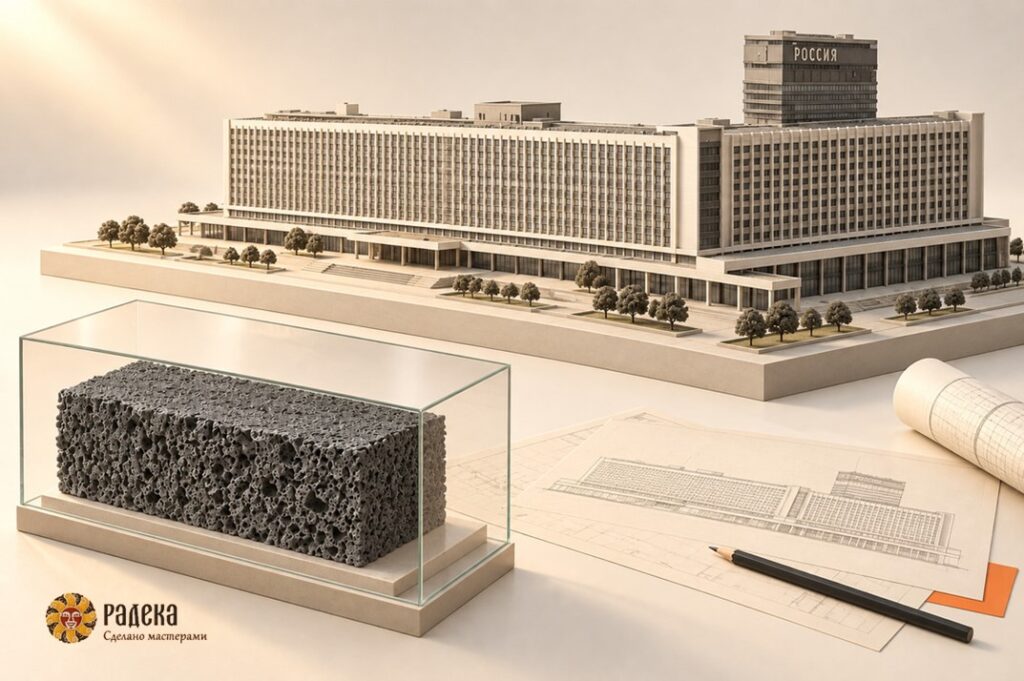
In the construction community, it is said that during the dismantling of the Moscow Hotel “Rossiya,” foam glass gravel was discovered, which had not lost its properties over decades of service. A beautiful story: the building is already being dismantled, and the insulation could still be useful. However, we did not find published results of the examination of the discovered material. Therefore, we will not assert that it retained all its original characteristics and was ready for reuse.
However, we found a documented example for foam glass plates. In January 2016, plates of FOAMGLAS S3, installed in 1973, were taken from the flat roof of a hospital in Kristianstad, Sweden. By the time of sampling, they had served 43 years. Tests were conducted by the Munich Institute for Thermal Protection FIW at the request of Pittsburgh Corning Europe.
In the FIW report E3.3-2017/05, thermal conductivity of 0.047 W/(m·K) and compressive strength of dry samples at 1480 kPa are indicated. Researchers assessed the thermal insulation properties as good after prolonged operation. The waterproofing of the examined roof remained intact, and no water accumulations were found.
This is already significant evidence of durability. It pertains to specific plates and conditions of their service; a passport for modern gravel is still needed. In the general conclusion of the FIW study, the preservation of high characteristics is also linked to proper waterproofing and low moisture levels in the structures. History confirms the material’s potential and simultaneously brings us back to the quality of the construction joint.
Foam glass gravel is governed by GOST R 59574-2021 “Gravel Based on Foam Glass. Technical Conditions”, developed by NIISF RAASN. Its status is confirmed in the official card of Rosstandart.
This standard provides for several grades of material, so there is no single density or strength for all foam glass gravel.
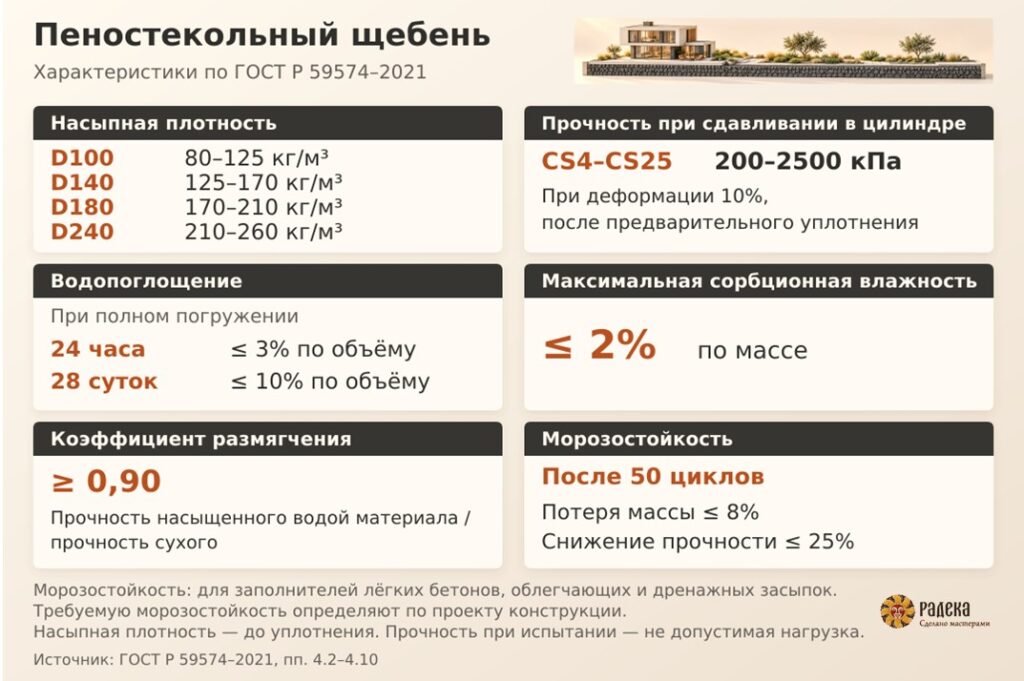
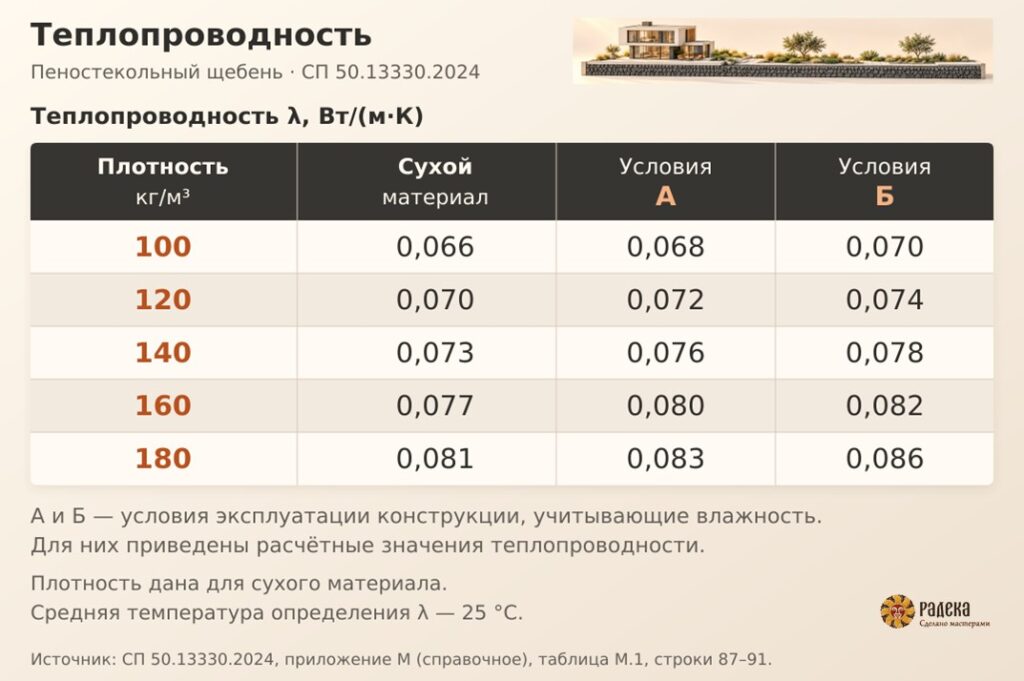
Data for thermal conductivity are provided in the reference appendix M, table M.1 SP 50.13330.2024 “Thermal Protection of Buildings,” lines 87–91. Values are indicated at an average temperature of 25 °C.
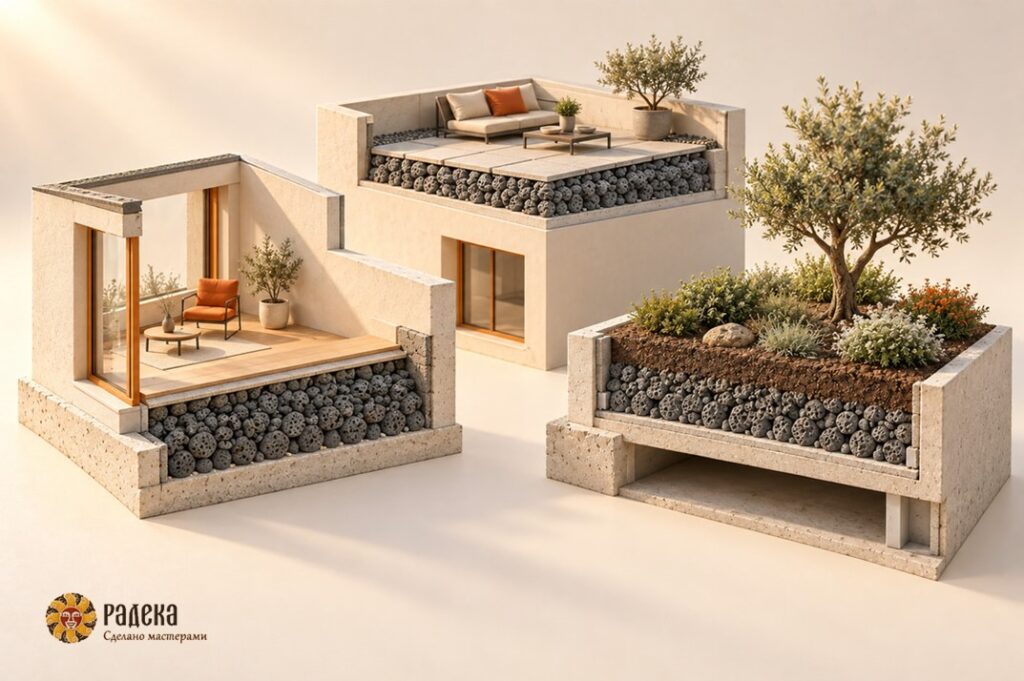
Foam glass gravel allows for the creation of an insulating layer and the formation of slopes towards the drains. The fill is conveniently distributed where height marks change. For an operable roof, a foundation for the covering is arranged above it as specified in the project; a calculated distribution structure is required for transport loads.
The gravel itself does not replace roof and terrace waterproofing.
Under the slab, the material can function as a load-bearing thermal insulation fill and a layer limiting capillary moisture movement.
However, the suitability of a specific grade is determined together with the condition of the soil, loads, and groundwater levels. The fill does not correct an unevenly prepared base. For a house, the decision to use it is made at the design stage when floor heights, perimeter insulation, and drainage can still be coordinated.
When hills need to be created above an underground parking lot, elevated areas, or to fill a large volume, the mass of ordinary fill can become a limitation. Foam glass gravel is used to lighten such structures.
At the same time, the plant soil, road surfaces, and other functional layers remain in place. Roots need suitable substrate, water requires organized drainage, and the slab must be calculated considering wet soil and all loads.
In road construction, the material is of interest where it is necessary to reduce the pressure of the embankment on weak foundations, provide thermal insulation, or lighten backfill.
Reducing its own weight helps to work with settlements; however, weak soil does not become strong because of this. Road embankments, retaining structures, and foundations require different design solutions.
For foam glass gravel, it is especially important to distinguish between closed cells inside the grain and the free space between particles. Water can be present in the fill, although the glass walls of the cells do not allow it to pass. There are also open pores on the surface of the fracture. Therefore, the promise of absolutely zero water absorption for the entire fill poorly aligns with real technical documents.
Operating conditions must be included in the thermal calculation.
Particular attention is paid to solutions with a high groundwater level.
If the fill is to drain water, it needs protected passages from siltation and a place for drainage. Filling a pit with a lightweight material and leaving water inside is a completely different structure.
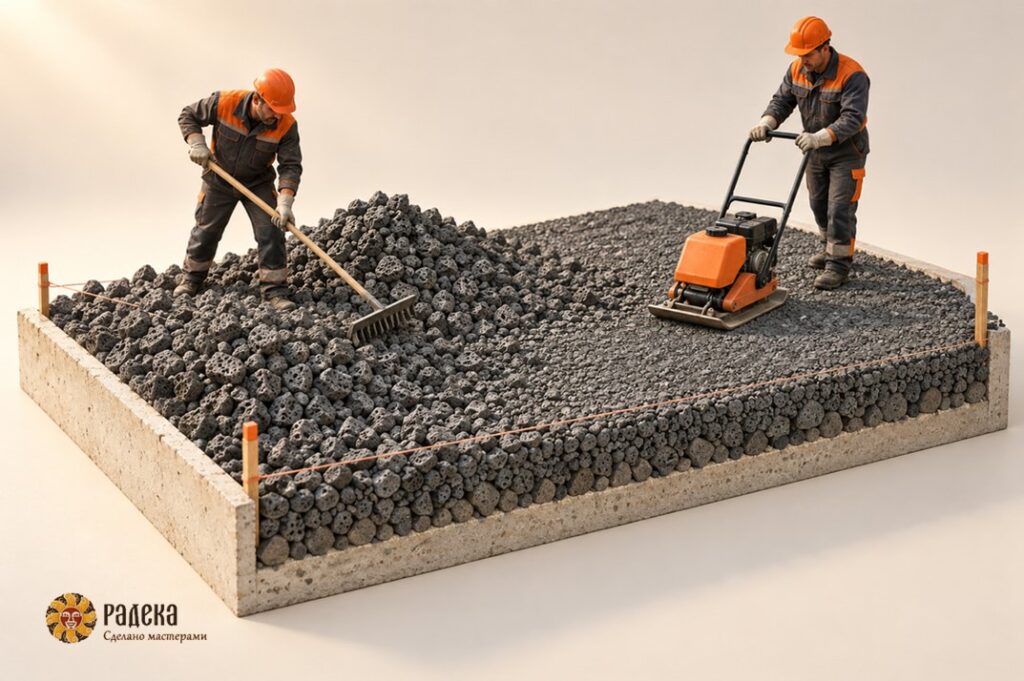
The fill has no seams between plates, but there is a requirement for uniform compaction. A layer simply poured from bags and leveled does not yet possess the design characteristics.
A ratio of 1.3:1 means that for 1 m³ of the finished compacted layer, approximately 1.3 m³ of loose material will be required. For an area of 100 m² and a thickness of 300 mm, this will result in 30 m³ of finished fill and about 39 m³ before compaction. This is a geometric estimate without a separate reserve for losses and delivery specifics.
With an unchanged area, a loose layer of 390 mm after such compaction will become 300 mm. The thickness reduction will be about 23%, so the expression “compact by 30%” can be misleading here.
At the site, the base and the project-specified separation layers are prepared sequentially, height marks are applied, material is distributed, and it is compacted layer by layer. Then, the thickness, evenness, and achieved degree of compaction are checked.
The equipment and thickness of the compacted layers are selected according to the specific foam glass gravel and project requirements. The advice to “pass over with any vibratory plate several times” does not work here: the result depends on the material characteristics and compaction mode. It is advisable to start with a test section to check the selected technology. When the required degree of compaction and project mark are achieved, work stops. Additional passes “for reliability” can increase gravel consumption without significant gains in load-bearing capacity.
During unloading and transferring gravel, dust is generated, so protective goggles and respiratory protection should be prepared in advance. These measures are necessary from the very beginning of working with the material, not just during its compaction.
It makes sense to choose foam glass gravel for a specific task: to lighten the structure, insulate the base, form a slope, or combine several functions. To compare the supplier’s offer with the project, the following will be needed:
It is more convenient to compare estimates based on the cost of the finished layer per square meter: including delivery, compaction coefficient, separating materials, and labor. Additionally, check how much height the solution will occupy. Good fill is not always convenient where only a few centimeters are left for insulation.
Reusability is also judged by the condition of the material. Clean extracted fill can be assessed for suitability for new work, but contamination with soil, remnants of mortar, and changes in fraction require inspection. The history of an old hotel does not replace such an assessment.
The discussion about foam glass gravel begins with working design: what loads act on the structure, where the water goes, and what the finished layer should be. Only then do its real advantages become useful — low weight, non-combustibility, and thermal insulation properties. The long biography of foam glass provides a good reason to consider it for those parts of the building that one does not want to revisit with major repairs.