Foam Glass Gravel in Construction
Foam glass gravel looks unremarkable: gray porous pieces, uneven edges, no decorative shine. Its function is usually not visible at all…
Read MoreOld tombstones were turned into steps and building blocks—thus preserving them for future generations. From the carved slabs of Krutitskoye Podvorye and the ruins of ancient Bolgar to modern facades: we trace the second life of limestone and examine why the durability of white stone depends not only on the material itself.
The occasion for this article was a recent excursion to the Krutitskoye Podvorye. Among the stories about old Moscow, the tale of white stone tombstones that were reused in construction particularly stood out. A slab bearing a person’s name could become part of a wall or foundation, and centuries later, reappear before us as a historical monument.
There is a bitter paradox in this. The loss of the original purpose sometimes gave the stone a chance to be preserved for future generations. The inscription disappeared from view but could survive within the masonry through time that would have erased it in the open air.
For us, this story has a quite modern continuation. Limestone is still chosen for facades, architectural details, and home finishes. Today, its fate depends on how well people understand the material they are working with.
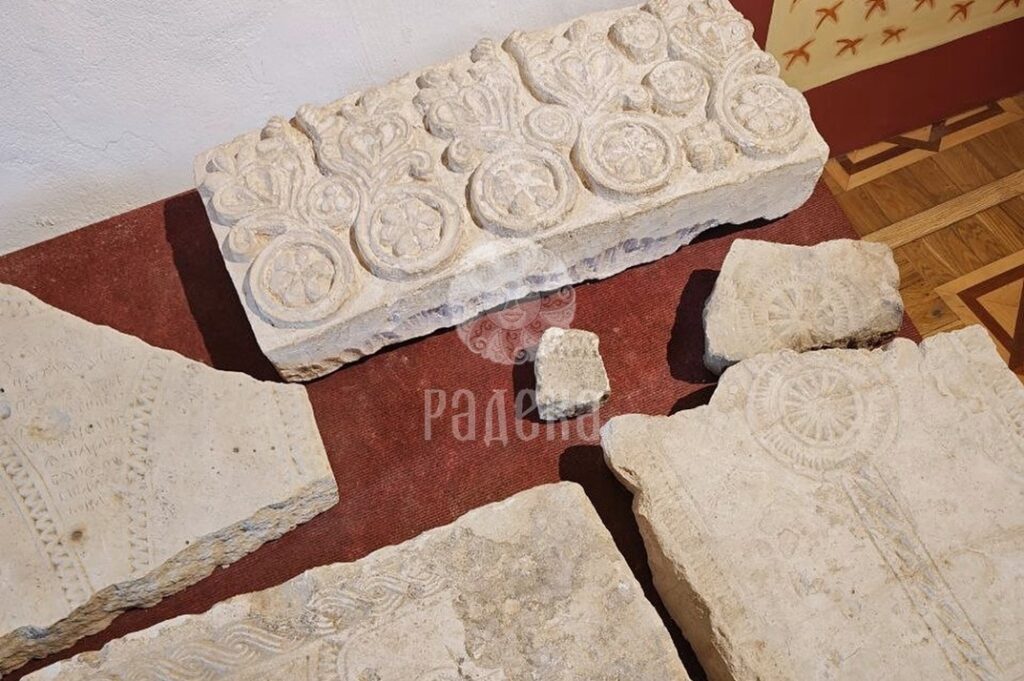
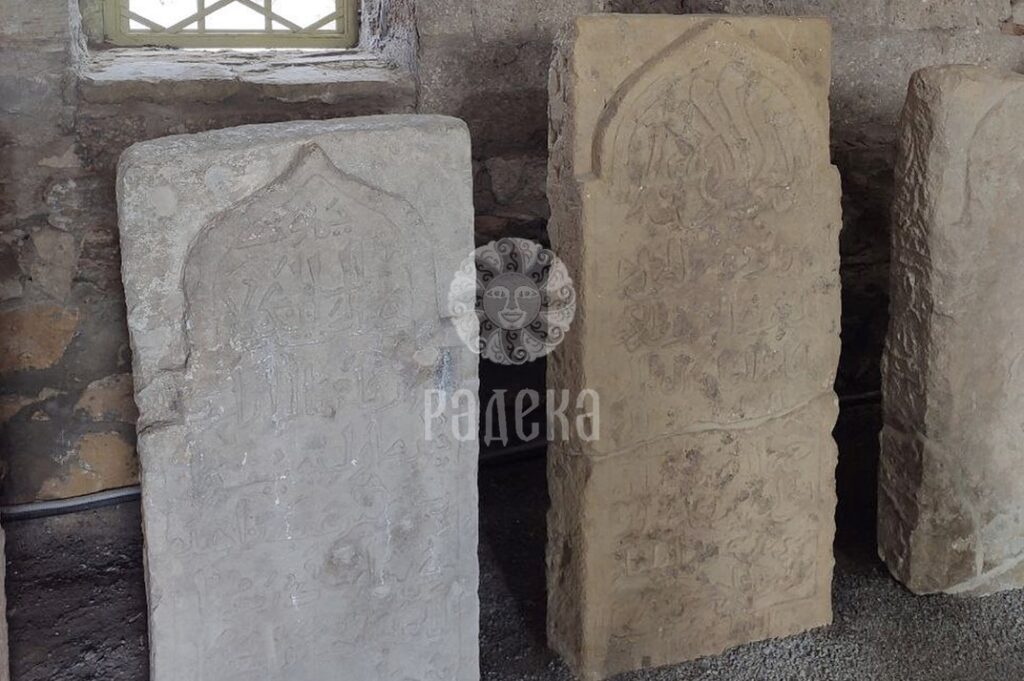
On the territory of the podvorye, there is a lapidarium—a collection of stone monuments. According to the “Krutitskoye Heritage” project materials, the collection includes over a hundred white stone tombstones created from the 15th to the 19th centuries. Among the monuments that underwent restoration work and tours are tombstones from the 15th to 17th centuries.
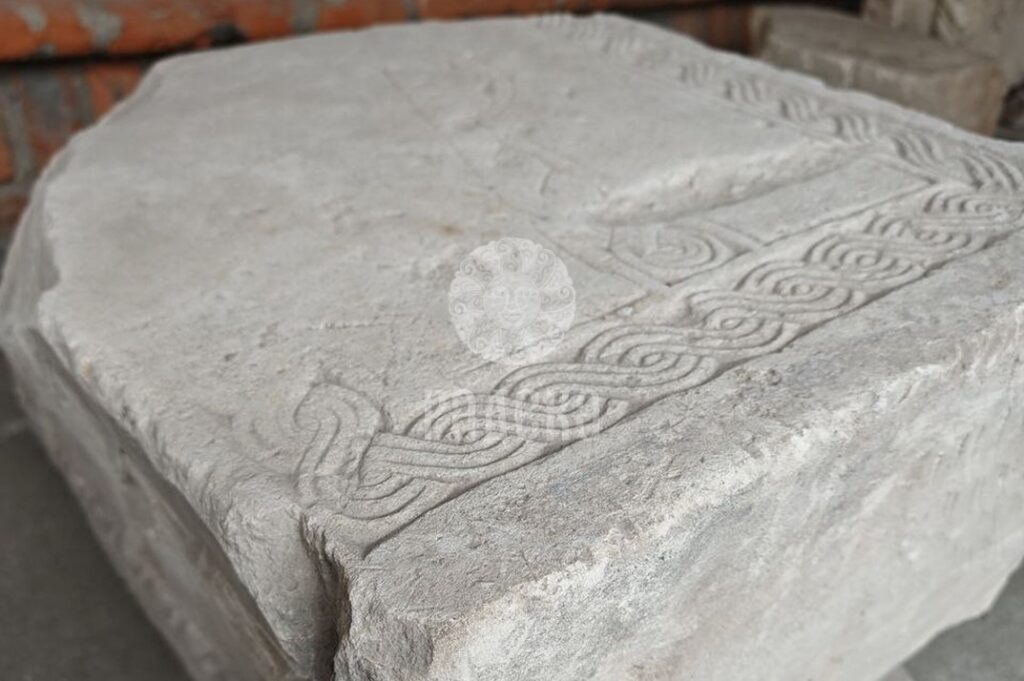
The slabs bear names, dates, ornaments, and tool marks. They tell us several things at once: about the person being commemorated, the skill of the carver, and the attitude of subsequent generations towards the memory of their ancestors.
They are also interesting from a professional perspective. Before us is a material that several centuries ago already allowed for working with form and fine details. The possibilities of limestone are known to modern craftsmen, although the tools and methods of installation have changed since then.
Limestone is a sedimentary rock, primarily composed of calcite, calcium carbonate. This is a large family of natural materials: the same name does not mean the same density, structure, and behavior in use.
Moscow white stone is part of this large family. In a study by archaeologist Leonid Belyaev, the deposits in the Moscow region, quarries in the basins of the Moskva River, Pakhra, and Oka, and extraction in open workings and underground quarries are described. The stone was transported by rivers and winter roads. It was made into building blocks, carved details, and tombstones.
Behind a finished slab was the labor of many people. The rock had to be extracted, a suitable blank selected, delivered, and processed. Even the hewn stone had economic value even when the original product ceased to be used.
Limestone was valued for its ease of processing. It allowed for carving reliefs, creating cornice profiles, and making inscriptions. At the same time, high-quality varieties of stone were selected for significant constructions. As Belyaev notes, such selection could complicate and increase the cost of work. The very origin of the material was not a guarantee of a good result.
The reuse of old slabs was a real construction practice. It should not be reduced to any one reason or historical event. Churches were reconstructed and expanded, areas of old cemeteries fell under new buildings, and burial practices changed.
Historian Sergey Shokarev, in a study on the use and preservation of ancient necropolises, considers, in particular, Belyaev’s explanation: slabs from graves that found themselves in construction zones could be used. This practice had economic and religious grounds that differed from today’s attitude towards monuments.
There are also specific examples beyond Moscow. The Uglich Museum reports that during the construction of the Church of Tsarevich Dmitry “on the blood” at the end of the 17th century, old tombstones were used in the foundation and niches of the altar.
For the stone, such restructuring could lead to various consequences. One slab was broken, another was reshaped, a third was laid in such a way that part of the inscription was preserved. Therefore, secondary use cannot be called an unequivocal salvation. It destroyed the original environment of the monument but sometimes left the stone and the text carved on it for future researchers.
During the excursion at Krutitskoye Podvorye, we were told that old tombstones were used in construction not only for economic reasons. The guide linked this to the reforms of Patriarch Nikon: according to this version, a special order commanded the removal of pre-reform slabs from cemeteries to erase the memory of the old church tradition. The laying of such stones in floors and steps was also explained as a deliberate humiliation—people were to literally trample the memory of the old faith.
This is a version that was voiced during the excursion. I could not find documentary evidence of the claim about Nikon’s special decree and its purpose. On the other hand, it is unlikely that such things would be documented in state papers. Perhaps only in memoirs. We will never know for sure.
The practice of reusing slabs existed even before Nikon’s reforms. Archaeologist Leonid Belyaev describes the foundation of the porch of the High-Petrovsky Monastery from the first half of the 17th century, made from tombstones of the 16th to early 17th centuries.
However, there is a specific document related to Peter I. A decree dated April 12, 1722, ordered that protruding tombstones be leveled with the ground. If it was impossible to place them this way, excess stones could be used in church construction. The text and reference to the Complete Collection of Laws of the Russian Empire is provided by Sergey Shokarev.
Another episode occurred in the same year, 1722. During a trip along the Volga, Peter I inspected ancient Bolgar. He was interested in the preserved structures and tombstones with inscriptions.
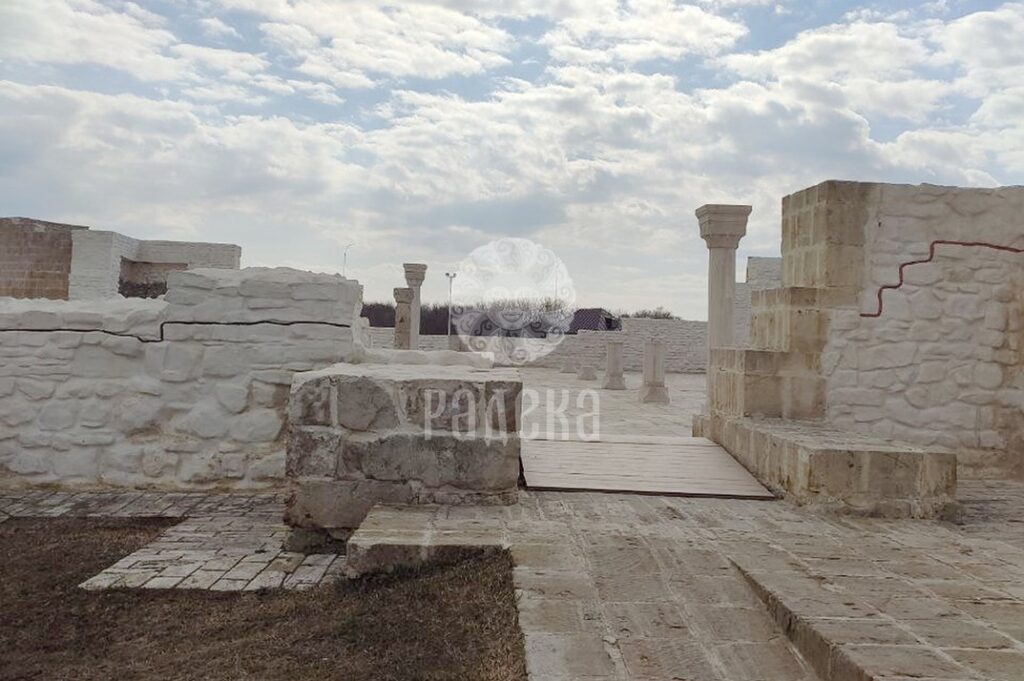
According to a publication by the Bolgar Museum-Reserve, the emperor ordered to strengthen the damaged foundation of the tower, and the texts of the tombstones—to be rewritten and translated. In a letter to the governor of Kazan, he demanded to send stonemasons with tools and lime for the repair of ancient structures.
However, this order did not mean that all monuments were safe from that moment on. A later testimony from Catherine II, cited in a study of Bulgar epigraphy, states that despite Peter’s instructions, stones from ancient structures and tombstones continued to be used for new constructions.
Such is the optimization.
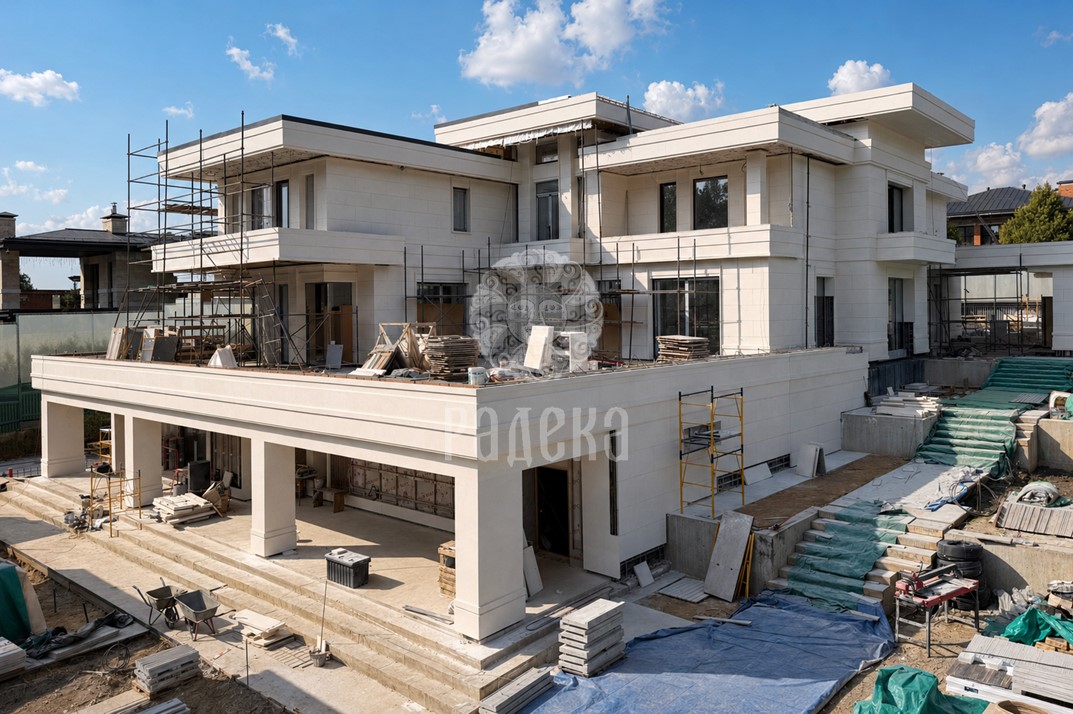
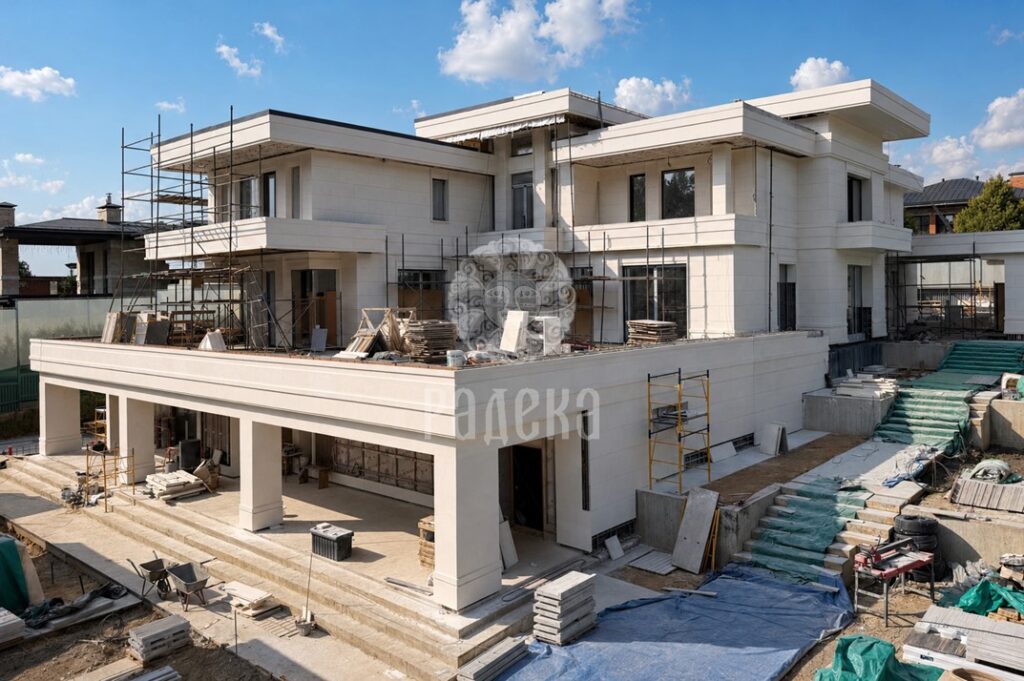
Today, limestone continues to be chosen for its calm shades, natural texture, and the ability to create expressive architectural details. It is suitable both for houses with window framing and for modern architecture with strict lines.
In the first case, the possibilities of carving and profiling are revealed. In the second, the selection of slabs, the pattern of joints, and the quality of connections are particularly noticeable. The more concise the facade, the more attention each detail attracts.
At the same time, historical white stone and modern facing limestone do not necessarily come from the same deposit and have the same properties. Choosing material based solely on a photograph or a beautiful trade name is insufficient.
For a future facade, a specific stone with clear characteristics is needed.
A preserved ancient monument showcases the possibilities of the material. However, its longevity cannot be automatically turned into a promise of durability for any new cladding. We see surviving examples; the history of losses usually remains beyond the beautiful photograph.
The first thing evaluated when selecting facade stone is its properties and working conditions. Water absorption, strength, frost resistance, and structural features are significant. For slabs with mechanical fastening, the stone’s performance at fastening points is also important. Specific requirements are determined for the chosen facade system and object.
The next question is water. Constant moisture, freezing of moisture in the pores, and crystallization of salts can damage the stone. Therefore, well-thought-out overhangs, cornices, joints, and water drainage are directly related to the preservation of the cladding.
The fastening system also requires calculation. The format and thickness of the slabs, their weight, the foundation, wind load, and the placement of fastenings are interconnected. These decisions are made at the design stage, before installation begins.
Finally, the material needs appropriate care. Limestone is sensitive to acids: a randomly chosen cleaning agent for removing construction dirt can damage the surface. Cleaning and protective treatment are selected for the specific stone and tested in advance. Impregnation will not correct a mistake in water drainage or fastening.
Ancient slabs bring us back to the simple thought: stone can outlive its first purpose. However, its preservation depends on people at every stage—from selecting the blank to caring for the finished product.
At RADEKA, we work with limestone and other types of natural stone as part of facade works and stone installation. For a new house, the history of the material becomes a useful professional lesson: beauty must be supported by precise processing, sound construction, and attention to detail.
For ancient slabs, a second life sometimes began by chance. For a modern limestone facade, a long life can be laid from the very beginning—right at the design stage.
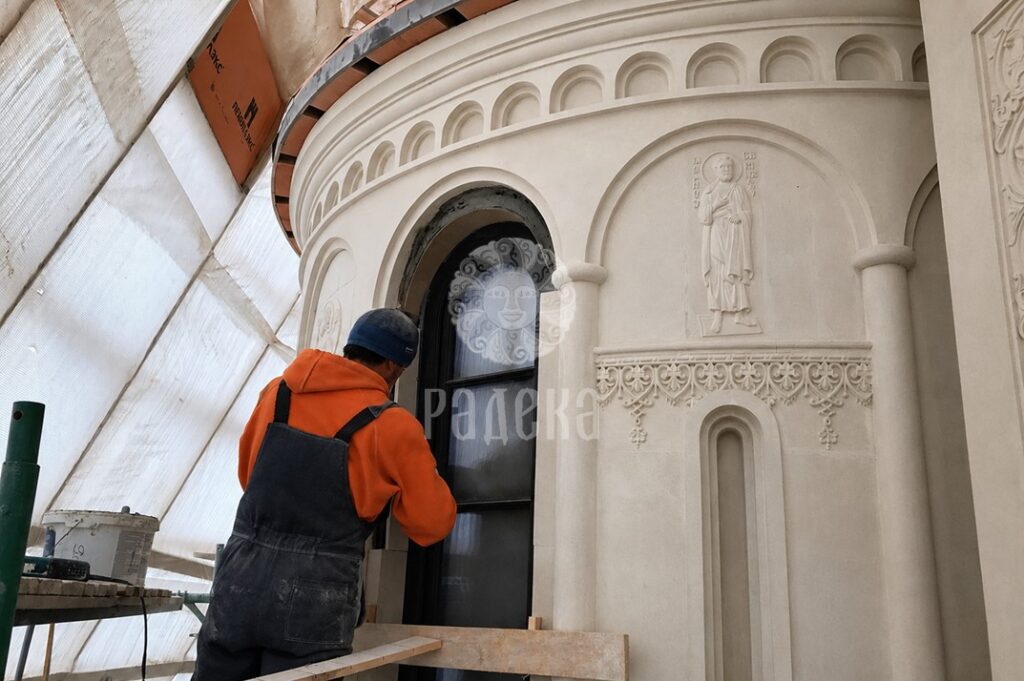 Working with limestone on the temple facade: arched frames, fine ornamentation, and relief carving.[/caption>